Immune Tonic — Field Notes
Tonicum Immunitatis
Autumn Into Winter: A Ritual of First Defence
As daylight thins and breath turns visible in the air, the body's vigilance shifts. This is when elderberries darken on the branch, when marshmallow roots grow dense beneath autumn soil, when the last blooms of echinacea stand sentinel through the first frosts.
The Immune Tonic honours this threshold — a measured response to the seasonal turn. Take it as the mornings grow cold, as children return to school, as gatherings move indoors. A small dose each day through the changeable weeks, or at the first tickle in the throat when you sense winter leaning in.
This is not the drama of crisis but the quiet foresight of care. The rhythm of immunity — alert, resilient, soft where it needs to be.
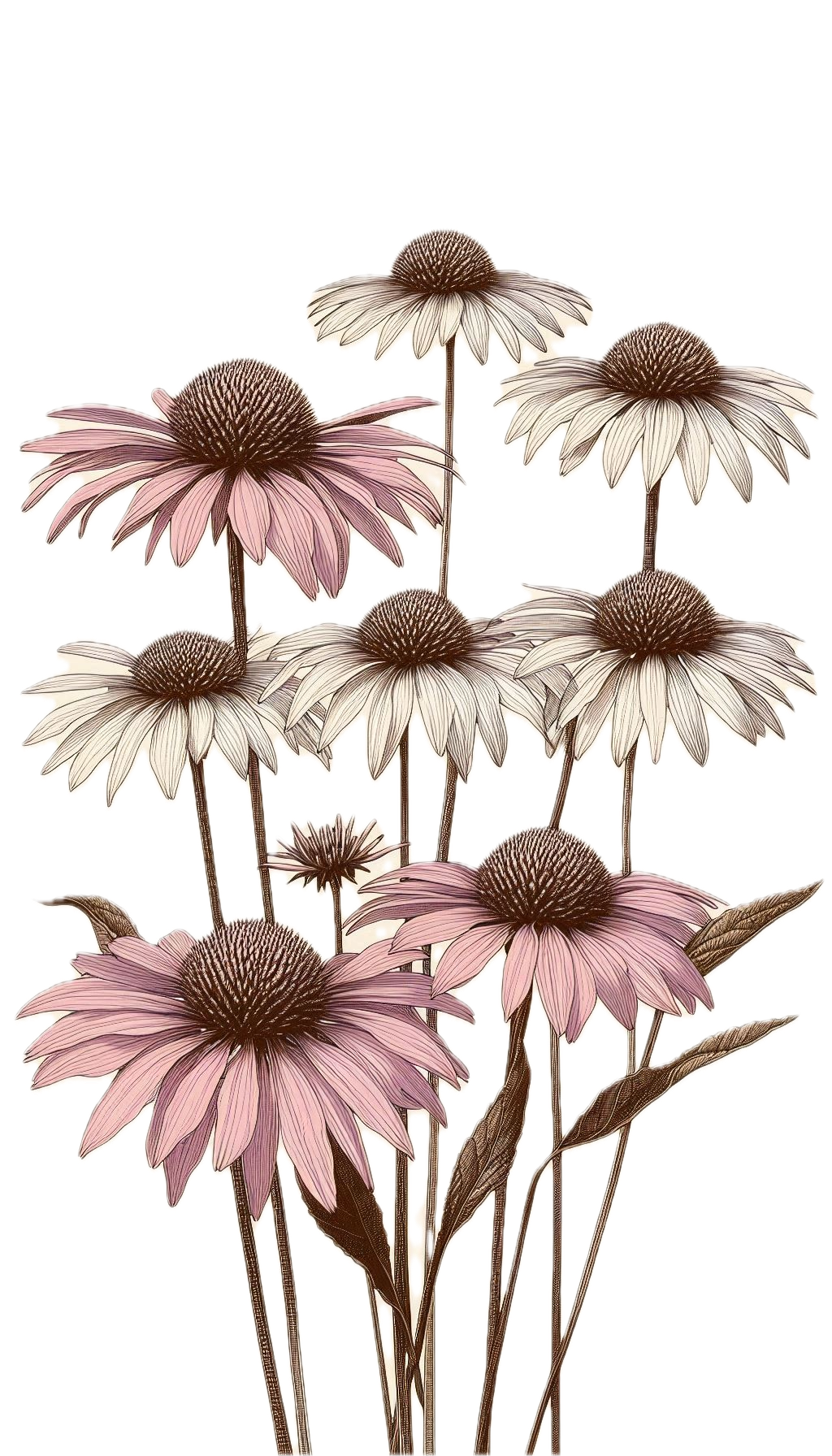
ECHINACEA PURPUREA
Purple Coneflower
Where It Lives
Rising from the prairies of North America — native to the Mississippi Valley, the Ozarks, and the Ohio Valley — coneflower favours dry open woods, prairies, and barrens. Overharvesting once reduced wild populations, but cultivation now protects this important species, feeding goldfinches and native bees into autumn.
The Harvest
Echinacea asks for patience. It takes three to four years for roots to mature. Modern herbal preparations more commonly use the aerial parts and pressed juice of E. purpurea, while Indigenous uses historically centred on the roots of related species such as E. angustifolia.
Folklore & Medicine
Among Plains peoples such as the Ute and Lakota, coneflower is revered as powerful medicine for coughs, sore throats, and venomous bites, and for ceremonial protection.
— Evidence Note: Contemporary research suggests support in reducing the duration of common colds when taken early and short-term.
THYMUS VULGARIS
Common Thyme
Where It Lives
Native to the sun-drenched slopes of the western and central Mediterranean, thriving on rocky soils where drought resilience shapes its aromatic strength.
The Harvest
Harvest June to September, before flowering, when essential oils peak. Clip young stems after dew lifts; dry out of direct light.
Folklore & Medicine
Egyptians used thyme in embalming. Greeks burnt it as temple incense — a symbol of courage. Medieval folklore held that thyme encouraged pleasant sleep and warded off nightmares. Hildegard of Bingen praised its respiratory virtues.
— Evidence Note: Aromatic oils (thymol/carvacrol) demonstrate antimicrobial and antispasmodic actions in vitro.
GLYCYRRHIZA GLABRA
Licorice Root
Where It Lives
Native from the Mediterranean through Western and Central Asia, especially along riverbanks and fertile soils.
The Harvest
Roots are gathered in autumn from mature 3–4-year-old plants. Lateral roots may extend several metres in deep soils, though cultivated harvests are typically shorter.
Folklore & Medicine
The Greek name glykyrrhiza means “sweet root.”
Recorded in Chinese materia medica since at least the 2nd century BCE, licorice harmonises formulas and soothes coughs. In Europe, the cleaned roots were chewed as a simple sweet.
— Evidence Note: Excessive glycyrrhizin can affect blood pressure and potassium; demulcent actions help calm throat and digestion.
ALTHAEA OFFICINALIS
Marshmallow Root
Where It Lives
Indigenous to Europe, Western Asia, and North Africa, growing along saltmarshes, river margins, and moist soils.
The Harvest
Roots are pulled in their second or third autumn once energy retreats below ground.
Folklore & Medicine
Marshmallow’s mucilage has calmed irritation for over two millennia. Original 19th-century sweets used the root, though modern marshmallows rely on gelatin. Its epithet officinalis affirms its medicinal esteem.
— Evidence Note: Demulcent polysaccharides coat and soothe irritated mucosa.
SAMBUCUS NIGRA
Elder
Where It Lives
Native throughout Europe and into Western Asia; hallmark of British hedgerows. Related species such as S. canadensisare common in North America.
The Harvest
Flower umbels bloom May–July; berries darken late September–October. Dead stems provide nesting habitat for solitary bees.
Folklore & Medicine
A tree of thresholds in Celtic lore — protective, magical, and deeply useful. Elderberries appear in archaeological sites since the Stone Age — testament to enduring value.
— Evidence Note: Extracts studied for reducing duration and severity of cold/flu-like symptoms; berries must be cooked before use.
These notes honour tradition and ecology. Full dosage and safety guidance live in the monographs.
Seasonal Tonics | Autumn into Winter — Jo Browne
© Jo Browne
References
USDA Natural Resources Conservation Service. (n.d.). Echinacea purpurea (L.) Moench. Plant Guide. https://plants.usda.gov/DocumentLibrary/plantguide/pdf/pg_ecpu.pdf
Master Gardener Volunteers of Northern Virginia. (2022). Echinacea purpurea (Purple Coneflower). https://mgnv.org/plants/native-plants/perennials/echinacea-purpurea/
Wikipedia contributors. (2025). Echinacea purpurea. Wikipedia, The Free Encyclopedia. https://en.wikipedia.org/wiki/Echinacea_purpurea
Go Botany. (n.d.). Echinacea purpurea (eastern purple coneflower). Native Plant Trust. https://gobotany.nativeplanttrust.org/species/echinacea/purpurea/
North Carolina State University Extension. (n.d.). Echinacea purpurea (Coneflower, Eastern Purple Coneflower, Purple Coneflower, Purple Rudbeckia). https://plants.ces.ncsu.edu/plants/echinacea-purpurea/
Hagers Handbuch. (2003). [History of a plant: the example of Echinacea]. PubMed. https://pubmed.ncbi.nlm.nih.gov/12808356/
Native Languages of the Americas. (n.d.). Native American Indian Coneflower (Elk Root) Medicine, Meaning and Symbolism. http://www.native-languages.org/legends-coneflower.htm
Wikipedia contributors. (2025). Echinacea. Wikipedia, The Free Encyclopedia. https://en.wikipedia.org/wiki/Echinacea
Athens Science Observer. (2021). A botanical and medicinal history of Echinacea. https://athensscienceobserver.com/2021/12/10/a-botanical-and-medicinal-history-of-echinacea-a-native-plant-of-the-southeast/
Traditional Medicinals. (n.d.). Echinacea - Benefits, Folklore, Botany and More. https://www.traditionalmedicinals.com/blogs/herb-library/echinacea
Kindscher, K. (2016). The Uses of Echinacea angustifolia and Other Echinacea Species by Native Americans. In: Echinacea. Springer, Cham. https://link.springer.com/chapter/10.1007/978-3-319-18156-1_2
Hobbs, C. (2023). Echinacea: From Native American Panacea to Modern Phytopharmaceutical. https://christopherhobbs.com/library/articles-on-herbs-and-health/echinacea-from-native-american-pancea-to-modern-phytopharmaceutical/
Indian Country Today News. (2017). A Wild History of Echinacea. https://ictnews.org/archive/a-wild-history-of-echinacea/
North Carolina State University Extension. (n.d.). Thymus vulgaris (Common Thyme, Garden Thyme, German Thyme, Thyme). https://plants.ces.ncsu.edu/plants/thymus-vulgaris/
Wikipedia contributors. (2025). Thyme. Wikipedia, The Free Encyclopedia. https://en.wikipedia.org/wiki/Thyme
Gardenia. (n.d.). Thymus vulgaris (Common Thyme). https://www.gardenia.net/plant/thymus-vulgaris
Keeler, K. H. (2016). Plant Story--Thyme and Its Folklore. A Wandering Botanist. http://khkeeler.blogspot.com/2016/07/plant-story-thyme-and-its-folklore.html
Wikipedia contributors. (2025). Thymus vulgaris. Wikipedia, The Free Encyclopedia. https://en.wikipedia.org/wiki/Thymus_vulgaris
Columbia Metro Magazine. (2022). About Thyme. https://columbiametro.com/article/about-thyme/
Worts & Cunning Apothecary. (2022). A Gentle Tonic - Thyme (Thymus vulgaris) Plant Profile. https://www.wortsandcunning.com/blog/a-gentle-tonic-thyme-plant-profile
A.Vogel. (n.d.). Thymus vulgaris L. (Common Thyme). https://www.avogel.ca/en/plant-encyclopedia/thymus-vulgaris.php
North Carolina State University Extension. (n.d.). Glycyrrhiza glabra (Black Sugar, Common licorice, Licorice, Liquorice). https://plants.ces.ncsu.edu/plants/glycyrrhiza-glabra/
Wikipedia contributors. (2025). Liquorice. Wikipedia, The Free Encyclopedia. https://en.wikipedia.org/wiki/Liquorice
Permaculture Plants. (2023). Learn How to Grow the Beautiful Licorice Plant: Glycyrrhiza glabra. https://permacultureplants.com/plants/licorice/
Royal Botanic Gardens, Kew. (n.d.). Glycyrrhiza glabra L. Plants of the World Online. https://powo.science.kew.org/taxon/urn:lsid:ipni.org:names:496941-1/general-information
Pastorino, G., Cornara, L., Soares, S., Rodrigues, F., & Oliveira, M. B. P. P. (2018). Glycyrrhiza glabra (Licorice): A Comprehensive Review on Its Phytochemistry, Biological Activities, Clinical Evidence and Toxicology. PMC. https://pmc.ncbi.nlm.nih.gov/articles/PMC8703329/
Garden Drum. (2016). How to grow and use licorice. https://gardendrum.com/2016/03/09/how-to-grow-and-use-licorice/
Asl, M. N., & Hosseinzadeh, H. (2008). Glycyrrhiza glabra. PMC. https://www.ncbi.nlm.nih.gov/pmc/articles/PMC7122586/
Britannica. (1998). Licorice | Root, Extract & Flavoring. https://www.britannica.com/plant/licorice
Wikipedia contributors. (2025). Althaea officinalis. Wikipedia, The Free Encyclopedia. https://en.wikipedia.org/wiki/Althaea_officinalis
First Nature. (n.d.). Althaea officinalis, Marsh Mallow: identification, distribution, habitat. https://www.first-nature.com/flowers/althaea-officinalis.php
Go Botany. (n.d.). Althaea officinalis (common marsh-mallow). Native Plant Trust. https://gobotany.nativeplanttrust.org/species/althaea/officinalis/
Worts & Cunning Apothecary. (2025). The Blessing of Softness: Marshmallow (Althea officinalis) Plant Profile. https://www.wortsandcunning.com/blog/marshmallow-plant-profile
HerbRally. (n.d.). Marshmallow Monograph. https://www.herbrally.com/monographs/marshmallow
Smithsonian Environmental Research Center. (n.d.). Althaea officinalis. Chesapeake Bay Introduced Species Database. https://invasions.si.edu/nemesis/chesreport/species_summary/althaea%20officinalis
Plantiary. (n.d.). Marsh-Mallow (Althaea officinalis) Plant Care & How to Grow, Water. https://plantiary.com/plant/althaea-officinalis_863.html
Assiniboine Park Conservancy. (2024). The Ancient Sweet Treat: Marshmallow Plant. https://www.assiniboinepark.ca/stories/213/the-ancient-sweet-treat-marshmallow-plant
Wikipedia contributors. (2025). Sambucus nigra. Wikipedia, The Free Encyclopedia. https://en.wikipedia.org/wiki/Sambucus_nigra
Lady Bird Johnson Wildflower Center. (n.d.). Sambucus nigra ssp. canadensis (Common elderberry). https://www.wildflower.org/plants/result.php?id_plant=sanic4
Vasileva, I., Farag, M. A., & Sõukand, R. (2024). From Supernatural to Ornamental: Black Elder (Sambucus nigraL., Family Adoxaceae) in Sweden. PMC. https://pmc.ncbi.nlm.nih.gov/articles/PMC11548546/
Native Plants PNW. (n.d.). Blue Elderberry, Sambucus nigra ssp. cerulea. https://nativeplantspnw.com/blue-elderberry-sambucus-nigra-ssp-cerulea/
Wikipedia contributors. (2025). Sambucus. Wikipedia, The Free Encyclopedia. https://en.wikipedia.org/wiki/Sambucus
Go Botany. (n.d.). Sambucus nigra (black elderberry). Native Plant Trust. https://gobotany.nativeplanttrust.org/species/sambucus/nigra/
North Carolina State University Extension. (n.d.). Sambucus canadensis (American Elder, American Elderberry, Common Elderberry, Elderberry). https://plants.ces.ncsu.edu/plants/sambucus-canadensis/
Penn State Extension. (n.d.). Elderberry in the Garden and the Kitchen. https://extension.psu.edu/elderberry-in-the-garden-and-the-kitchen
Seasonal Tonics | Autumn in winter by Jo Browne
© Jo Browne