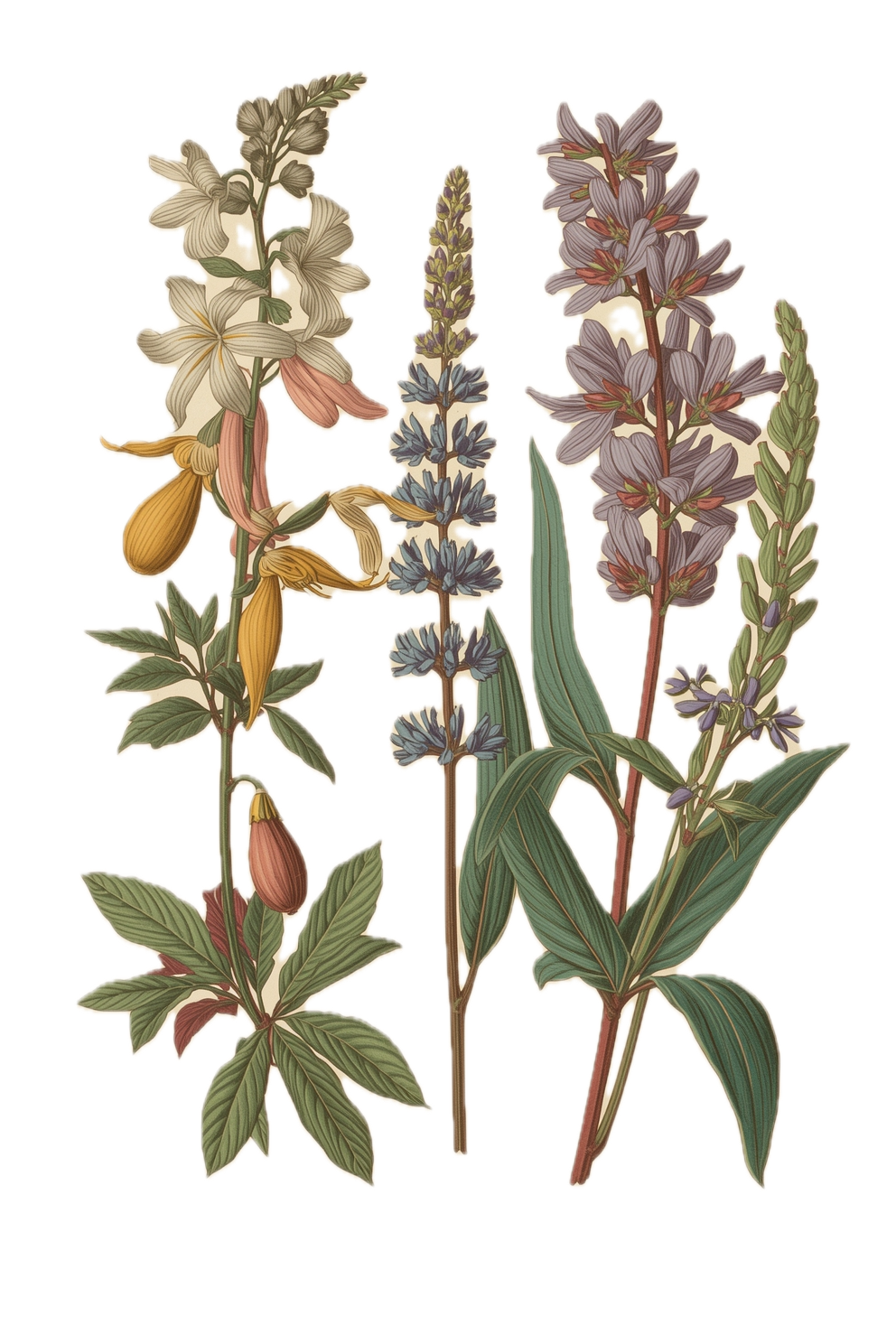
Sleep Infusion — Field Notes
Infusio Somni — Formula Quietis
Autumn Into Winter: A Ritual of Nightly Renewal
As darkness comes earlier and sleep grows more elusive, the body calls for plants that ease the transition from waking to rest. This is when we turn to the gentle nervines—those that soften circular thoughts, that quiet mental overactivity, that help the nervous system remember how to yield.
The Sleep Infusion is an evening companion. Brew it thirty to sixty minutes before bed as part of a ritual of winding down. Let passionflower smooth nocturnal transitions. Let lemon balm settle the gut-brain axis and usher calm to thoughts. Let lavender ground and center with its aromatic balm for the senses. Let skullcap calm frazzled nerves and restore parasympathetic balance. Let rose harmonize the heart where worry burdens.
This is not the drama of sedation but the gentle intelligence of plants that know how to coax the body toward its nightly work—repair, renewal, the soft exhale into sleep. A quietened mind, a loosened breath, and the body's remembering of rest.
Passiflora incarnata
Maypop, Purple Passionflower
Where It Lives
Passionflower climbs wild across the southeastern United States—from Delaware to Missouri, south to eastern Texas and Florida, and north through Bermuda. The vine thrives in disturbed meadows, fields, roadsides, woodland edges, and prairies, where it climbs with axillary tendrils up fences and over other plants, reaching lengths of twenty-five feet. It is the Tennessee state wildflower. The Cherokee called it ocoee—the Ocoee River and valley are named after this plant, which has been a staple food and medicine for thousands of years.
The Harvest
The flowers bloom two to three times per year across a fifty to sixty-five day flowering period from June through September, their intricate blue-white petals unfurling for just a single day before fading. Harvest occurs while the plant is in full bloom, when medicinal potency peaks. The aerial parts—stems, leaves, and flowers—are cut and dried for later use. The name "maypop" comes from the hollow yellow fruits that pop loudly when crushed underfoot in autumn.
Folklore & Medicine
The name Passiflora comes from Latin passio (suffering) and flos (flower)—the "passion flower"—because Jesuit missionaries in the seventeenth century saw in its complex blooms all the instruments of Christ's Passion. The ten petal-like parts represented the disciples (excluding Peter and Judas); the five stamens, the five wounds; the knob-like stigmas, the three nails; the radiating fringe, the crown of thorns. The stemmed ovary was interpreted as the cup or the post to which Christ was bound during flagellation.
The plant was first discovered by Spanish doctor Monardes in Peru in 1569, forty years before it was introduced to Europe as an ornamental. Long before European contact, passionflower was well known to South American and Native American peoples as medicine. The Cherokee used it to treat nervousness, mental tension, and sleep disorders. Native peoples poulticed the root for boils, cuts, bruises, earaches, and inflammation, and brewed the leaves into tonic teas to soothe the nerves. The Inca made it a ceremonial plant, and it has been used in sacred rituals for centuries.
In Western tribes like the Ute, the plant was called "elk root" because wounded elk were believed to seek it as medicine. Passionflower was consumed during sweat lodge ceremonies and the Sundance. European settlers and folk herbalists learned how to use passionflower from Cherokee tribes and brought it back to Britain in the nineteenth century, introducing more people to its relaxing benefits.
In 1773, passionflower became a common treatment in North America for hysteria and the hydrophobia caused by rabies—earning it the folk name "Mad Dog Skullcap." It appeared in the first American Materia Medica in 1785. The plant is also the exclusive larval host for the Gulf fritillary butterfly, whose orange-winged adults drink nectar from the intricate blooms.
Melissa officinalis
Lemon Balm, Bee Balm
Where It Lives
Lemon balm is native to south-central Europe, the Mediterranean Basin, Central Asia, and Iran, though it has naturalized throughout the Americas and beyond. The perennial herb thrives in rich, moist soil under full sun to partial shade, growing bushy and upright to about one meter tall. It spreads vigorously from seed and vegetative fragments, and in mild climates the stems die back in winter only to shoot up again in spring.
The Harvest
Leaves are harvested by hand in June and August in the northern hemisphere, on dry days to prevent the crop from turning black if damp. The harvest should occur three to five times per year before buds form, in the leaf state when essential oils are most concentrated. Cut in the early morning after dew has dried but before the high sun. The whole plant is covered with a soft down, and even as it emerges from earth in spring, it offers its characteristic sweet lemon fragrance.
Folklore & Medicine
The genus name Melissa comes from the Greek word for "honeybee"—mélissa—because the flowers are magnets for bees. The species officinalis marks its traditional use in apothecaries. In Greek mythology, Melissa was the nymph who discovered honey and nursed the infant Zeus with it. Nymphs were said to be able to take the form of bees. These bee-nymphs, named the Melissae in her honor, nursed Zeus, granting him power to become king of the gods. Bees were also sacred to Artemis, and priestesses who served her were given the bee honorific title.
According to folklore, apiarists of old would rub the leaves of lemon balm inside older hives, inducing new swarms to remain and take them over. The plant has been planted near beehives since at least the sixteenth century—Virgil and Pliny reported that leaves of lemon balm were rubbed on new beehives to entice bees. Lemon balm contains many of the same chemicals found in bee pheromones.
The medical use of lemon balm has a two-thousand-year tradition. In the tenth century, Arab physicians used the plant to fortify the heart and treat melancholy. Persian physicians called it "the gladdening herb." In the Capitularies of Charlemagne in the ninth century, the first Holy Roman Emperor ordered it planted in every monastery garden, so beautiful and valuable to health did he find it.
By medieval times, lemon balm was scattered across Tudor floors as a strewing herb—when crushed underfoot, the leaves released their fruity perfume, sweetening the air and dispelling disease. Queen Elizabeth I would have no other herb in her chambers. English botanist Nicholas Culpeper considered lemon balm to be ruled by Jupiter in Cancer and suggested it for weak stomachs, to make the heart "merry," to help digestion, to open obstructions of the brain, and to expel melancholy vapors from the heart and arteries.
Carmelite Water—created by French Carmelite nuns in the fourteenth century—featured lemon balm as its main ingredient alongside angelica, lemon peel, and nutmeg. It was said to restore youth and prevent fainting spells, and it is still sold in German pharmacies today. Sixteenth-century herbalist John Gerard praised its ability to "drive away melancholy."
Drinking a cup of lemon balm tea daily was said to lengthen the lifespan considerably. Llewelyn, prince of Glamorgan in the thirteenth century, drank it daily and lived to one hundred eight years. John Hussey of Sydenham reportedly lived to one hundred sixteen years with the same practice. Paracelsus, the great physician, thought lemon balm one of the most important herbs, even able to restore life.
Lavandula angustifolia
English Lavender, True Lavender
(See Muscle Salve Field Notes for full botanical details on this calming plant)
Despite its common name, English lavender is native to the Mediterranean—Spain, France, Italy—where it thrives in rocky, well-drained soil under full sun. The genus name Lavandula comes from Latin lavare, "to wash," referencing its use in Roman baths and purification rituals. Ancient Egyptians used lavender in mummification. Greeks and Romans valued it for bathing and scenting linens. Cleopatra wore its scent to seduce both Julius Caesar and Marc Antony.
In Christian tradition, the Virgin Mary laid Jesus's swaddling clothes on a lavender bush, imparting the herb with its calming fragrance. In folklore, lavender was used to summon fairies on Midsummer's Eve and was believed to ward off evil spirits. Medieval brides wore crowns of lavender blossoms symbolizing purity and devotion. Knights carried sprigs into battle for protection. Lavender placed under pillows brought prophetic dreams and prevented nightmares. During the Black Plague, its antimicrobial properties offered real protection.
Scutellaria lateriflora
Skullcap, Mad Dog Skullcap
Where It Lives
Skullcap is native to North America, thriving in moist, shady riparian habitats—forests, thickets, meadows, and marshes from Canada south through the eastern and central United States. The perennial grows sixty to eighty centimeters tall with characteristic square stems and jagged-edged leaves, hallmarks of the mint family. It spreads by rhizomes and runners, forming colonies where water levels rise and fall. The plant is a wetland-loving species, content to grow where soil stays damp and rich.
The Harvest
Farmers and collectors harvest the plants while they are flowering—the peak of their herbal power—from May to August. The entire plant above ground is cut about three inches above the soil, then hung in small bunches in a dark, dry location to preserve potency. Leaves and stems are used fresh or dried. The plant can be cut multiple times per season if managed carefully, though the first flush of flowers carries the greatest concentration of therapeutic compounds.
Folklore & Medicine
The common name "skullcap" describes the shape of the flower's calyx, which resembles miniature medieval helmets worn by European soldiers. The dainty blue flowers are formed by two tongue-like petals that together create the helmet shape. Some say the flowers look like helmets in the shape of skulls. Others imagine that fairies use the tiny blue blooms as hats—similar to the folklore surrounding foxglove.
During the nineteenth century, the common name used in America was "mad dog"—in 1773, Scutellaria lateriflorabecame a common treatment in North America for the hysteria and hydrophobia caused by rabies. Though this use has fallen away, the name persists as a folk memory of the plant's calming powers over agitated minds and frayed nerves.
Cherokee women used skullcap as an emmenagogue and to promote women's health. Native American tribes consumed it as a tea to soothe the nerves and sometimes used it in ceremony. European settlers and folk herbalists learned how to use skullcap from Cherokee tribes. Herbal physicians then brought it back to Great Britain in the nineteenth century, introducing more people to its relaxing benefits.
Skullcap appears in the first American Materia Medica published in 1785. It has over two centuries of therapeutic use and was historically applied in the treatment of digestive disorders, kidney problems, postpartum stimulation of the reproductive system, sore throat, breast and eye pain, and as a remedy for nervous disorders.
Unlike stronger relaxing herbs like valerian that make people sleepy, skullcap has the uncanny ability to soothe the nerves without slowing you down. It softens stiff muscles, eases tension held too tightly in the body, and calms the frazzled nervous system—restoring parasympathetic balance without sedation.
Rosa damascena
Damask Rose, Rose of Damascus
Where It Lives
The Damask rose is a hybrid born seven thousand years ago on the border between Turkmenistan, Uzbekistan, and Afghanistan. Following the last Ice Age, Rosa gallica blew east to Central Asia. Rosa fedtschenkoana migrated north over the Himalayas as the climate warmed. Here they met a wild Himalayan rose, Rosa moschata, and together produced a uniquely fragrant offspring. From its birthplace in Central Asia, the rose traveled the Silk Road to Persia, Syria, and eventually Europe. It is optimally cultivated in hedgerows to protect the blooms from wind damage. In Bulgaria's Valley of Roses—the region around Kazanlak and Karlovo—damask roses are grown in long hedges, while in Turkey, individual plants are spaced apart along trenches.
The Harvest
Gathering the flowers is intense manual labor concentrated in a period of twenty to thirty days from April through June, depending on climate and altitude. The harvesting period can be as long as a month in cooler conditions and as short as sixteen to twenty days in hotter seasons. Roses are picked in the evening or during very early morning hours—starting at five or six o'clock when the roses' fragrance is at its best. Roses must be harvested before noon to preserve scent and aroma, and they wilt rapidly once cut. They are placed in refrigerators or cool places until distillation, which must occur within twelve to twenty-four hours or the flowers lose half their oil yield. Tradition holds that the first picked rose of the day should be placed behind the harvester's ear.
Folklore & Medicine
The Damask rose takes its name from Damascus, the capital of Syria, where it was cultivated and became synonymous with beauty and fragrance. In Arabic, the rose is called Ward Joury, likely after the Iranian city of Jar where the rose originates. The earliest culinary records of the rose date to Mesopotamia around the seventh century BCE—cuneiform tablets attest that roses were essential ingredients in medical preparations and seasonings. Rose wine was made and exported from Persia as far back as two thousand years ago.
Crusaders brought the Damask rose to Europe in the fourteenth century, though other accounts suggest the ancient Romans brought it to their colonies in England, or that the physician of King Henry VIII gifted him one circa 1540. Regardless of how it arrived, the rose quickly became a symbol of love, beauty, and the divine feminine across cultures.
For centuries, the Damask rose has symbolized beauty and love. In ancient Greece and Rome, Aphrodite (Venus to the Romans)—goddess of love, beauty, and passion—was often associated with roses. One legend tells that when Aphrodite emerged from the sea, she was draped in rose blossoms. The white rose, representing purity, became associated with the Virgin Mary in Christian tradition. Roses were planted around homes and churches to protect against witches and evil spirits.
In Persian tradition, rose gardens were places of contemplation and spiritual connection. The fragrance of roses was believed to lift the soul closer to the divine. In medieval and Renaissance Europe, rose water was used extensively in both sweet and savory dishes. By the tenth century, rose water had become a commonly used flavor for cakes, cookies, and pastries. Medieval herbalists used roses for headaches, nausea, to strengthen the heart, and to dispel irritability.
Traditionally, rose water was used as an antiseptic for eye washing and mouth disinfecting, and as an antispasmodic for alleviating abdominal pains and chest congestion. Rose petal decoctions treated digestive problems, menstrual bleeding, and strengthened the heart. Generations of women have known that rose water can ease menstrual cramps and reduce inflammation. Midwives have long administered rose water as a muscle relaxant for childbirth.
To produce just one five-milliliter bottle of rose essential oil requires more than ten thousand freshly picked rose blossoms—a labor-intensive process that renders it one of the most precious oils in the world.
These notes honour tradition and ecology. Full dosage and safety guidance live in the monographs.
Seasonal Tonics | Autumn into Winter — Jo Browne
© Jo Browne
References
A.Vogel. (n.d.). Passiflora incarnata L. (Passion flower). Plant Encyclopaedia. https://www.avogel.com/plant-encyclopaedia/passiflora_incarnata.php
Lady Bird Johnson Wildflower Center. (n.d.). Passiflora incarnata (Maypop). Native Plants of North America. https://www.wildflower.org/plants/result.php?id_plant=pain6
Wikipedia contributors. (2025). Passiflora incarnata. Wikipedia, The Free Encyclopedia. https://en.wikipedia.org/wiki/Passiflora_incarnata
Florida Native Plant Society. (n.d.). Passiflora incarnata – Purple Passionflower. https://www.fnps.org/assets/pdf/pubs/passiflora_incarnata_purplepassionflower_2-1.pdf
North Carolina State University Extension. (n.d.). Passiflora incarnata (Apricot Vine, Maypop, Passionflower, Passion Flower, Passion Vine). https://plants.ces.ncsu.edu/plants/passiflora-incarnata/
Sun God Medicinals. (n.d.). Herb Spotlight - Passionflower. https://sungodmedicinals.com/pages/herb-spotlight-passionflower
USDA Natural Resources Conservation Service. (n.d.). Purple Passionflower Passiflora incarnata L. Plant Guide. https://plants.usda.gov/DocumentLibrary/plantguide/pdf/pg_pain6.pdf
USDA PLANTS Database. (n.d.). Passiflora incarnata L. https://plants.usda.gov/plant-profile/PAIN6
Washington College. (n.d.). Purple Passionflower - Passiflora incarnata. https://www.washcoll.edu/learn-by-doing/lifelong-learning/plants/passifloraceae/passiflora-incarnata.php
Altnature. (n.d.). Passionflower Herb Uses. https://altnature.com/gallery/passionflower.htm
Wallflower Studio Garden. (2019). Some virtues, folklore, and use of lemon balm and mint. https://wallflowerstudiogarden.com/2019/03/24/lemon-balm/
Wikipedia contributors. (2025). Lemon balm. Wikipedia, The Free Encyclopedia. https://en.wikipedia.org/wiki/Lemon_balm
Herbal Academy. (2025). Lemon Balm: The Immortal Life of Bees. https://theherbalacademy.com/blog/lemon-balm/
Patheos Pagan. (2021). The Magick Of Melissa. https://www.patheos.com/blogs/witchofthewoodwithravenwood/2021/04/the-magick-of-melissa/
Learn About Nature. (2023). Lemon Balm. https://www.learnaboutnature.com/plants/herbs/lemonbalm/
Herbal Legacy. (n.d.). History of Lemon Balm. https://www.herballegacy.com/Morrison_History.html
Eldrum Herbs. (n.d.). Lemon Balm Melissa officinalis. http://www.eldrumherbs.co.uk/content/content_files/profiles_lemon-balm_melissa-officinalis.php?state=1
A.Vogel. (n.d.). Melissa officinalis L. (Lemon Balm). Plant Encyclopaedia. https://www.avogel.com/plant-encyclopaedia/melissa_officinalis.php
Herb Pharm. (n.d.). Lemon Balm Melissa officinalis. https://www.herb-pharm.com/pages/melissa-officinalis
Smokable Herbs. (2025). Lemon Balm Benefits, Uses, and Safety: An Overview. https://smokableherbs.com/plant/lemon-balm/
Traditional Medicinals. (n.d.). Skullcap - Benefits, Folklore, Botany and More. https://www.traditionalmedicinals.com/blogs/herb-library/skullcap
Wikipedia contributors. (2025). Scutellaria lateriflora. Wikipedia, The Free Encyclopedia. https://en.wikipedia.org/wiki/Scutellaria_lateriflora
The Homestead Garden. (2024). How to Grow Skullcap. https://www.thehomesteadgarden.com/skullcap/
Traditional Medicinals. (n.d.). Skullcap 101. https://www.traditionalmedicinals.com/articles/plants/skullcap-101/
Naturopaths & Herbalists Association of Australia. (2024). Herb of the Month - Scutellaria Lateriflora or Skullcap. https://nhaa.org.au/herb-of-the-month-scutellaria-lateriflora-or-skullcap/
Lady Bird Johnson Wildflower Center. (n.d.). Scutellaria lateriflora (Blue skullcap). https://www.wildflower.org/plants/result.php?id_plant=SCLA2
Wikipedia contributors. (2025). Scutellaria. Wikipedia, The Free Encyclopedia. https://en.wikipedia.org/wiki/Scutellaria
Missouri Botanical Garden. (n.d.). Scutellaria lateriflora. Plant Finder. https://www.missouribotanicalgarden.org/PlantFinder/PlantFinderDetails.aspx?taxonid=281434
Joshee, N., Patrick, T. S., Mentreddy, R. S., & Yadav, A. K. (2002). Skullcap: Potential medicinal crop. Trends in new crops and new uses, 580-586. https://hort.purdue.edu/newcrop/ncnu02/v5-580.html
Oshala Farm. (2018). Skullcap-Regenerative Organic Certified®. https://oshalafarm.com/shop/skullcap/
Wikipedia contributors. (2025). Rosa × damascena. Wikipedia, The Free Encyclopedia. https://en.wikipedia.org/wiki/Rosa_%C3%97_damascena
AramcoWorld. (2022). The Long Wandering of the Damascus Rose. https://www.aramcoworld.com/articles/2022/the-long-wandering-of-the-damascus-rose
Petal & Poem. (2024). Rosa damascena (Damask Rose) and Its Origins. https://www.petalandpoem.com/floral-thoughts/the-rosa-damascena-damask-rose-and-its-origins
Al Haush. (n.d.). Rosa Damascena – the Lebanese queen of flowers. https://www.alhaush.com/blogs/al-haush-stories/rosa-damascena-the-lebanese-queen-of-flowers
Food Heritage Foundation. (2020). The everlasting love story with Rosa Damascena. https://food-heritage.org/the-everlasting-love-story-with-rosa-damascena/
Equinox Apothecary. (2024). Rose (Damask) Rosa × damascena. https://equinoxapothecary.co.uk/blogs/herbal/rose
Widrlechner, M. P. (1981). History and utilization of Rosa damascena. Economic Botany, 35(1), 42-58. https://link.springer.com/article/10.1007/BF02859214
A Tapir's Tale. (n.d.). Queen of Roses. https://www.tapirstale.com/pages/queen-of-roses
Plants Rescue. (n.d.). Rosa Damascena. https://www.plantsrescue.com/posts/rosa-damascena
Seasonal Tonics | Autumn in winter by Jo Browne
© Jo Browne