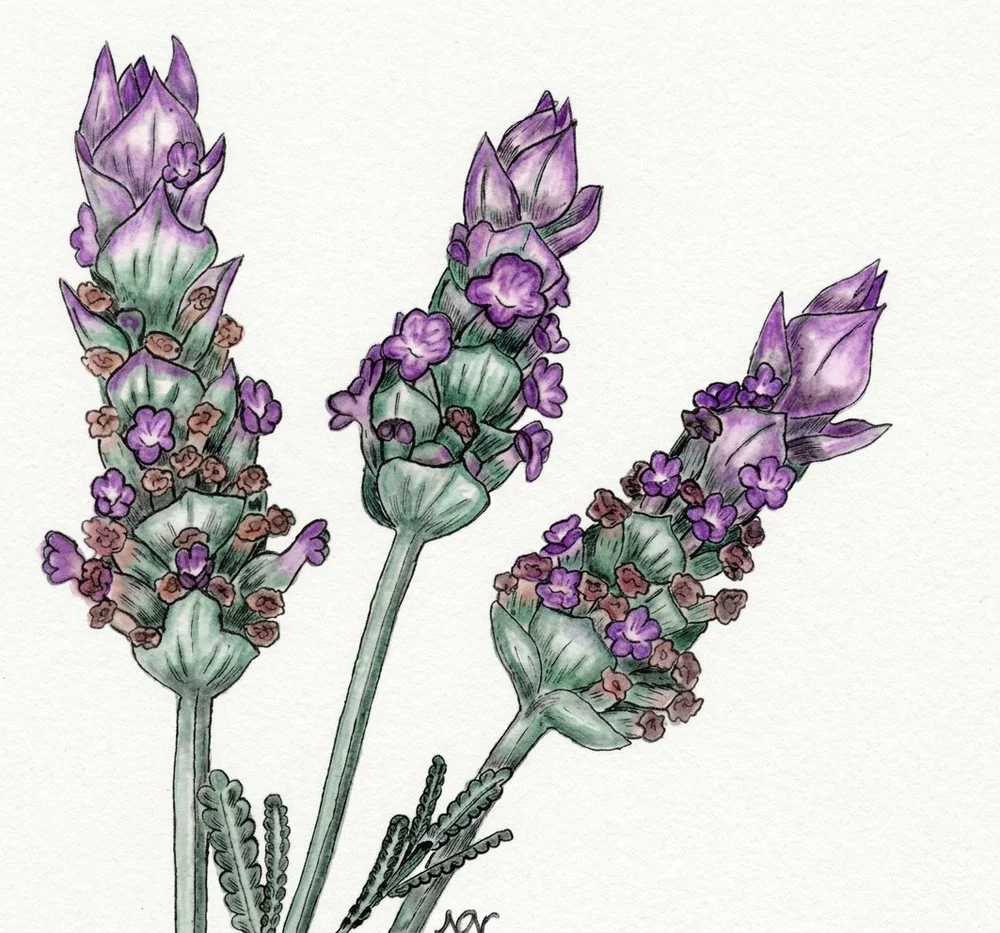
In winter the night arrives before most of us are ready for it, and bedtime can drift later and later under electric light. A small, repeated ritual at the same time each evening is one of the simplest ways to tell the body the day is over.
Lavender was once London’s own. The fields at Mitcham, a few miles from Herne Hill, grew it by the acre, and lavender sellers walked the streets calling “Who will buy my sweet lavender?” Bunches were laid in linen chests and hung by beds, so that clean sheets and lavender became, for generations, the same smell.
The Lavender Sleep Mist is the water left behind when lavender is distilled, softer than the oil and closer to the living flower.
This is the mist for the pillow, ten minutes before the light goes out.
The Plant in the Field
Lavandula angustifolia
Fine lavender, distilled and left as water
The spikes are cut in July, when half the flowers are open, and steam-distilled. The oil rises and is separated; the fragrant water left behind is the hydrosol. It holds only a trace of the oil, with the plant’s softer, water-loving compounds, which is why it smells gentler and greener than lavender oil.
Formulator’s Note
I use this the same way every night: two sprays on the pillow, one on the inside of the duvet, then lights out. Whether the scent itself becomes a cue for sleep is a popular idea rather than a proven one, but the ritual is worth having for its own sake.
In the morning it does a second job, misted over the face after the balm, a cool, toning finish.
One plant, one note, for the longer nights.
These notes honour tradition and ecology. Full dosage and safety guidance live in the monographs.
References
Meta-analysis of lavender essential oil inhalation and sleep, 11 RCTs, 628 adults (2025). Holistic Nursing Practice. PubMed 40600743.