IDescription
Two flowers, at the lowest strength in the collection, in a plain, light base. This balm is for little backs and feet, for teething days, sniffly nights and every unsettled hour in between, and the rub matters as much as the balm: warm hands, three slow breaths together, long strokes down a small back while the room goes quiet. There is no menthol, no eucalyptus and nothing sharp. It makes no promise about coughs or colds. It is comfort, given gently, whenever it is needed.
IIComposition
| Plant (part) | % | Actions |
|---|---|---|
| Vitis vinifera (grapeseed oil) | Base | Light carrier |
| Cera alba (beeswax) | Body and protection | |
| Lavandula angustifolia (organic essential oil) | 0.15% | Calming aromatic |
| Chamaemelum nobile (organic essential oil) | 0.10% | Soothing aromatic |
IIIThe Plants
Lavandula angustifolia
Lavender: the bedtime scent
WHERE IT LIVES
The fine lavender of the western Mediterranean mountains, long grown in English fields and gardens.
THE HARVEST
The flowering spikes are cut in high summer and steam-distilled for their oil.
FOLKLORE & TRADITIONAL USE
Generations of mothers have tucked lavender into pillows and cot linen. It is one of the few oils that secondary safety guidance lists for babies from three months, at very low dilution.
EVIDENCE NOTE
There is no trial evidence for lavender oil on babies’ skin for sleep or settling. Its use here is traditional and sensory, at a dilution within published guidance for infants.
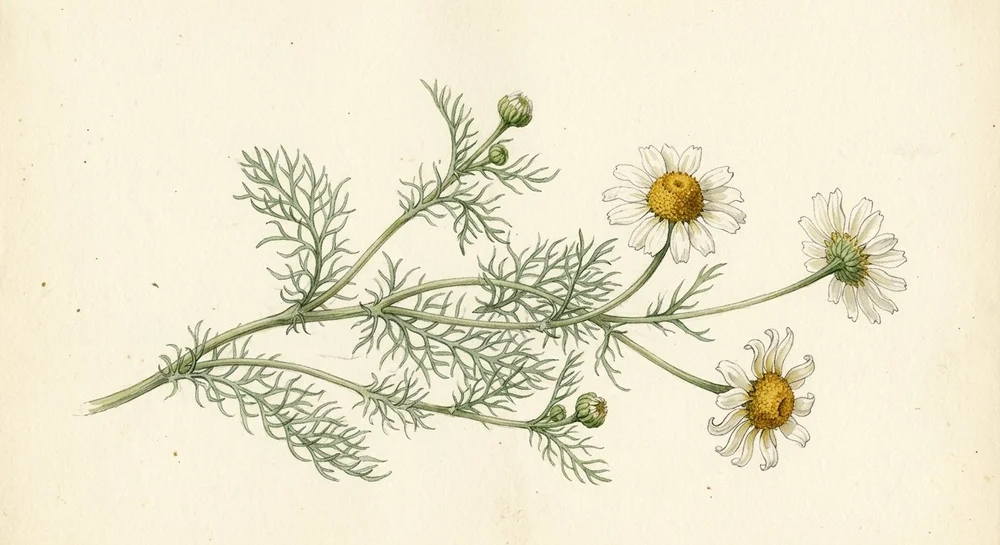
Chamaemelum nobile
Roman chamomile: the plant’s physician
WHERE IT LIVES
A low, creeping, apple-scented perennial of western Europe’s sandy grasslands and commons, once planted as fragrant lawns.
THE HARVEST
The small daisy-like flowers are gathered in summer and steam-distilled for a pale oil with a sweet, apple note.
FOLKLORE & TRADITIONAL USE
It earned the name Roman chamomile in the sixteenth century, after a botanist found it growing near Rome. Gardeners called it the plant’s physician, believing it revived ailing plants nearby. In the nursery it has long been the gentle choice.
EVIDENCE NOTE
Secondary safety guidance places Roman chamomile, with lavender and dill, among the few oils considered for babies from three months at 0.1-0.25% total, applied to the back or feet and never near the face. Roman chamomile is a daisy-family plant.
How It Works as a Formula
The formula is deliberately small. Two of the gentlest oils, kept to 0.25% in total, in grapeseed oil and beeswax, with nothing cooling, camphor-like or cineole-rich, because menthol near an infant’s nose has caused breathing to pause in a few children under one.
What it offers is a ritual: warmth, scent and touch at the same time each night, the kind of routine that helps small bodies settle.
IVDose & Safety
APPLY
Babies 3 months to 2 years: a pea-sized amount to the back or the soles of the feet. Children 2 and over: a small amount to the chest and back. Up to twice daily, once at bedtime.
CAUTIONS
Not for babies under 3 months. Never apply to the face or hands, or near the nose or mouth. Patch test on the inner arm or leg for 24 hours before first use. Avoid with a daisy-family allergy. Contains a naturally occurring fragrance allergen, linalool. External use only. Stop if irritation occurs, and keep out of reach of children.
IMPORTANT
This balm is for comfort only and does not treat coughs, colds or breathing problems. For a blocked-nose baby, the NHS suggests saline drops. If a baby or young child is struggling to breathe, seek medical help straight away.
Apothecary’s Summary
A soft lavender and chamomile balm for comfort through a little one’s cold, by day or at bedtime. Two flowers, kept gentle, and a few quiet minutes at the end of the day for the smallest people in the house.
References
NHS Healthier Together. Cough and cold in children: advice for parents and carers.
Review of menthol and reflex apnoea in infants. Scientific Research Publishing (SCIRP).
Tisserand, R. and Young, R. (2014). Essential Oil Safety, 2nd edition. Churchill Livingstone.