When a cold arrives, the body asks for very simple things: warmth, fluid and rest. The old household answer was a hot drink, a blanket and an early night, and it has lasted because it works with the body rather than against it.
The plants for that hot drink once grew within easy reach. Elderflower was picked from the hedge in June and dried for exactly this moment; yarrow grew on every verge; peppermint came, for two centuries, from the fields at Mitcham, a few miles from Herne Hill. Hot elderflower, yarrow and peppermint, taken to bring on a sweat, is one of the oldest cold remedies in British herbal practice.
The Cold & Flu Infusion is that hot drink, warmed with Ceylon cinnamon, sharpened with hibiscus and grounded with nettle.
This is the cup for the afternoon you realise you are coming down with something. Make it, sit down, and stop.
The Plants in the Field
Sambucus nigra (flower)
Elderflower, early summer dried for winter
In late May and June the elder is covered in flat, cream heads that smell of muscat and honey. They are picked on a dry morning, fully open, and dried quickly to keep their colour. In the English kitchen they became cordial and champagne in summer, and in winter, hot tea for a cold.
Achillea millefolium
Yarrow, Achilles’ herb of the verge
Feathery leaves and flat white flowers on every roadside, lawn and field margin from June to the first frosts. Its name comes from Achilles, said to have used it on his soldiers’ wounds; its place in the cold-weather teapot comes from centuries of country practice.
Mentha × piperita
Peppermint, once the pride of Mitcham
A hybrid of water mint and spearmint, first described in England in 1696. Within a century Mitcham, just south of here, was growing it by the field, and Mitcham peppermint oil was prized across Europe. In the cup it brings the cool, open lift.
Cinnamomum verum
Ceylon cinnamon, the true cinnamon
The inner bark of young shoots of a Sri Lankan laurel, peeled by hand after the rains and left to curl into fine, layered quills. Softer and sweeter than the cassia sold as cinnamon in most kitchens, and the source of the warmth in the cup.
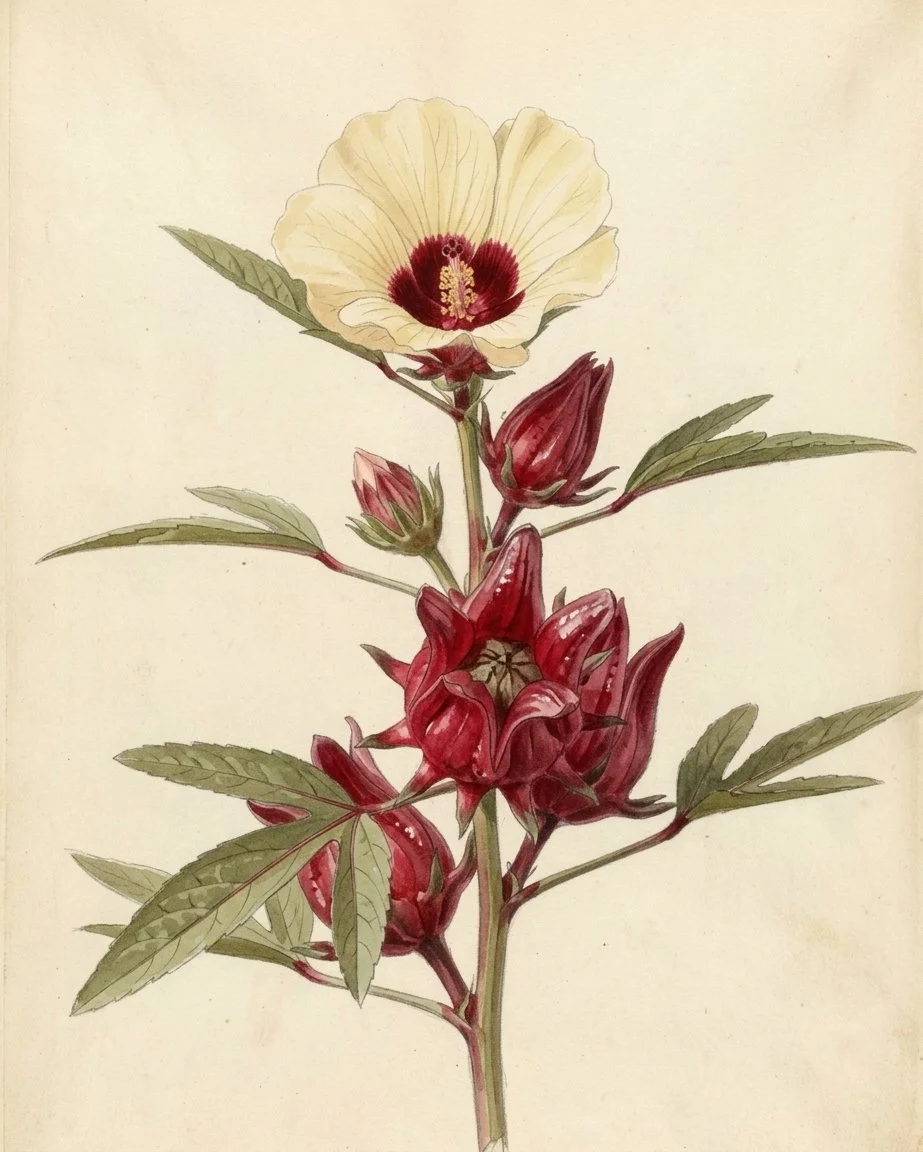
Hibiscus sabdariffa
Roselle, the red calyx
Not the petals but the fleshy red calyx that swells around the seed pod once the flower fades. Drunk as karkadé in Egypt, bissap in Senegal and agua de Jamaica in Mexico, it gives the tea its tartness and its ruby colour.
Urtica dioica
Nettle, the green backbone
The first green of spring, picked young and dried, so that a little of April goes into a winter cup. Nettle has been spun into cloth, cooked into soup and steeped as a tonic for as long as people have lived beside it.
Formulator’s Note
I am often asked what to do at the start of a cold, and the honest answer begins with rest. This tea is partly there to make rest happen: you cannot drink something this hot quickly, and holding the cup is a reason to sit down.
Elderflower and yarrow are the traditional heart of it, the plants households reached for when a cold began. Peppermint opens and cinnamon warms. Hibiscus I added for its tartness and its colour, because a tea people enjoy is a tea people actually drink. Nettle is the quiet one, the green plant underneath that keeps the blend grounded.
Six plants, steeped red, for the first days of a cold.
These notes honour tradition and ecology. Full dosage and safety guidance live in the monographs.
References
European Medicines Agency, HMPC. European Union herbal monograph on Sambucus nigra L., flos.
Grieve, M. (1931). A Modern Herbal. Ray, J. (1696). Synopsis Methodica Stirpium Britannicarum, 2nd edition.