IDescription
Six plants, steeped red. This is the oldest remedy there is for a cold, a hot drink and an early night, made a little more deliberate. Elderflower and yarrow carry the tradition, peppermint opens, cinnamon warms, hibiscus gives the tartness and the colour, and nettle sits underneath as quiet nourishment. Drink it hot, and let the cup be the reason to stop.
IIComposition
| Plant (part) | Actions |
|---|---|
| Hibiscus sabdariffa (calyx) | Tart, colouring; mildly hypotensive |
| Sambucus nigra (flower) | Diaphoretic; traditionally for early cold symptoms |
| Achillea millefolium (herb) | Aromatic bitter; traditionally diaphoretic |
| Mentha × piperita (leaf) | Aromatic; carminative; cooling |
| Cinnamomum verum (bark) | Warming; aromatic; carminative |
| Urtica dioica (leaf) | Nutritive; traditional tonic |
IIIThe Plants
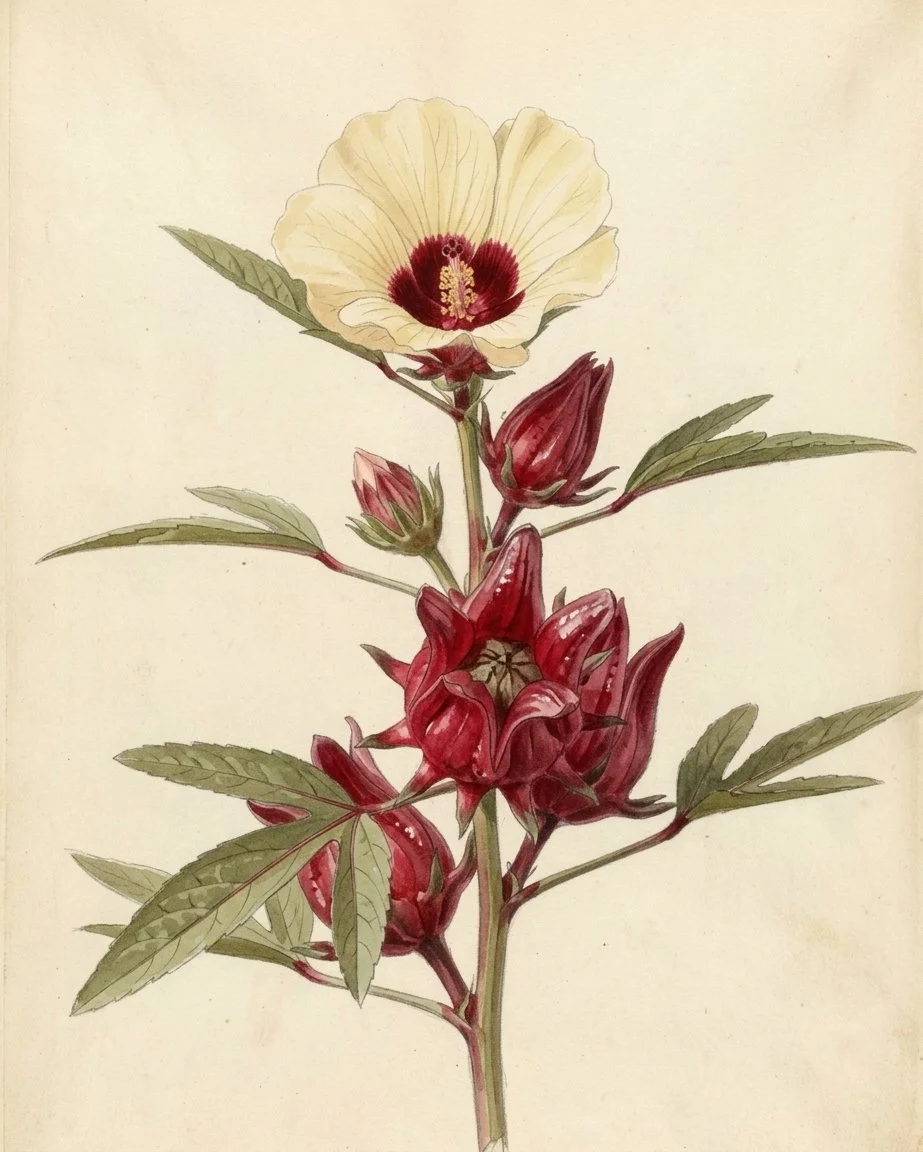
Hibiscus sabdariffa
Roselle: the red calyx
WHERE IT LIVES
A tropical annual of the mallow family, probably first domesticated in West Africa and now grown across the tropics.
THE HARVEST
Once the flower fades, the fleshy red calyx swells around the seed pod. It is picked by hand and dried in the sun.
FOLKLORE & TRADITIONAL USE
Karkadé in Egypt and Sudan, bissap in Senegal, agua de Jamaica in Mexico: across three continents it is a drink of hospitality, served hot in winter and cold in summer.
EVIDENCE NOTE
No human trials for colds were found. Trials in adults show hibiscus tea lowers systolic blood pressure by around 7 mmHg on average, which is why it carries a caution. Its role here is flavour, colour and tradition.
Sambucus nigra (flower)
Elderflower: the cream of early summer, kept for winter
WHERE IT LIVES
The same hedgerow shrub that gives elderberries, found across Europe on woodland edges, farm tracks and waste ground.
THE HARVEST
The flat cream heads are picked in late May and June on a dry, sunny morning, when fully open and scented, and dried quickly to keep their colour.
FOLKLORE & TRADITIONAL USE
Hot elderflower tea was the household way to bring on a sweat and break a fever. Grieve records elderflower with peppermint as an old remedy for colds and influenza.
EVIDENCE NOTE
The European Medicines Agency recognises elderflower as a traditional herbal medicine for the early symptoms of a cold, in adults and young people over 12. There are no clinical trials. Nothing was found for flu.
Achillea millefolium
Yarrow: Achilles’ herb
WHERE IT LIVES
Grassland, field margins and lawns across Europe and temperate Asia, its feathery leaves and flat white flower heads common in late summer.
THE HARVEST
The flowering tops are cut in summer, on a dry day, and dried in bunches.
FOLKLORE & TRADITIONAL USE
Its name comes from Achilles, said to have used it on his soldiers’ wounds at Troy, and its old English names include soldier’s woundwort. With elderflower and peppermint it makes the classic hot fever tea of British herbal practice.
EVIDENCE NOTE
The European Medicines Agency recognises yarrow for appetite and mild digestive complaints, not colds. Its place in cold-weather teas rests on long practice rather than research.
Mentha × piperita
Peppermint: the cool lift
WHERE IT LIVES
A natural hybrid of water mint and spearmint that favours damp, rich ground. It was first described in England by John Ray in 1696.
THE HARVEST
The leaves are cut just before flowering, when the menthol-rich oil is strongest, and dried away from sunlight.
FOLKLORE & TRADITIONAL USE
Mitcham, a few miles from Herne Hill, was once the centre of English peppermint growing, and Mitcham peppermint oil was prized across Europe through the eighteenth and nineteenth centuries.
EVIDENCE NOTE
The European Medicines Agency recognises peppermint leaf for traditional digestive use, not colds. Menthol gives a sensation of cool, open breathing. Its role here is aroma and lift.
Cinnamomum verum
Ceylon cinnamon: the true cinnamon
WHERE IT LIVES
An evergreen tree of the laurel family, native to Sri Lanka, where most true cinnamon is still grown.
THE HARVEST
After the rains, young shoots are cut and the inner bark peeled away by hand, then left to curl into fine, layered quills.
FOLKLORE & TRADITIONAL USE
One of the oldest traded spices, valued in ancient Egypt and Rome. Herodotus told a story of great birds building nests from cinnamon sticks on unreachable cliffs, a tale that helped keep its source a secret.
EVIDENCE NOTE
Ceylon cinnamon contains far less coumarin than the cheaper cassia, which is why it is specified here. It is used for warmth and flavour, and traditionally for digestion.
Urtica dioica
Nettle: the green backbone
WHERE IT LIVES
Rich, disturbed ground across the temperate world: field edges, old gardens and anywhere people have kept animals.
THE HARVEST
The young tops are picked in spring, before flowering, and dried. Drying removes the sting.
FOLKLORE & TRADITIONAL USE
Nettle fibre was spun and woven into cloth for centuries, and in Hans Christian Andersen’s The Wild Swans a sister knits nettle shirts to save her brothers. In the kitchen it was the first green of spring.
EVIDENCE NOTE
The European Medicines Agency recognises nettle leaf for traditional use but not under 12, for lack of data. Here it is traditional nourishment, giving the blend a green, mineral depth.
How It Works as a Formula
Elderflower and yarrow are the heart of it: the hot, sweating tea that households have reached for at the start of a cold for generations. Peppermint opens and cools, cinnamon warms the finish, and together they make the cup something you want to hold.
Hibiscus gives the tartness and the ruby colour, and nettle sits beneath it all, the plain green plant that keeps the blend grounded.
IVDose & Safety
DOSE
Infuse 1 teaspoon in freshly boiled water, covered, for 10-15 minutes. Adults and children 7+: 1-3 cups daily.
CAUTIONS
Not for children under 7. Not for use in pregnancy or breastfeeding. Avoid with an allergy to the daisy family (yarrow), the mint family (peppermint) or Peru balsam (cinnamon). Take care with low blood pressure or blood-pressure medicines (hibiscus).
DURATION
A cup a day through the colder months, or up to three from the first signs of a cold. If cold symptoms worsen or last more than a week, seek medical advice.
Apothecary’s Summary
A red, warming tea for the first days of a cold. Six plants that each carry a piece of the old household remedy, steeped together so that the drinking of it becomes the rest it is meant to bring.
References
European Medicines Agency, HMPC. European Union herbal monograph on Sambucus nigra L., flos.
European Medicines Agency, HMPC. European Union herbal monograph on Achillea millefolium L., herba.
European Medicines Agency, HMPC. Community herbal monograph on Mentha × piperita L., folium.
European Medicines Agency, HMPC. Community herbal monograph on Urtica dioica L., Urtica urens L., folium.
Meta-analysis of Hibiscus sabdariffa and blood pressure in adults (2022). PubMed 34927694.
AGES, Austrian Agency for Health and Food Safety. Coumarin in cinnamon.
Grieve, M. (1931). A Modern Herbal. Ray, J. (1696). Synopsis Methodica Stirpium Britannicarum, 2nd edition.