IDescription
Four plants for the longer nights. Valerian is the root of it, earthy and slow, the oldest sleep herb in the European tradition. Passionflower steadies a mind that will not settle, and lemon balm and lavender soften the whole, so that what is taken half an hour before bed tastes of the evening rather than the medicine cabinet. It works best given time: nightly, for a week or two, as the season asks for more sleep.
IIComposition
| Plant (part) | Actions |
|---|---|
| Valeriana officinalis (root and rhizome) | Sedative; anxiolytic; antispasmodic |
| Passiflora incarnata (aerial parts) | Anxiolytic; mild sedative |
| Melissa officinalis (leaf) | Calming nervine; carminative |
| Lavandula angustifolia (flower) | Calming nervine; aromatic |
IIIThe Plants
Valeriana officinalis
Valerian: the old root of sleep
WHERE IT LIVES
A tall perennial of damp meadows, riverbanks and ditches across Europe and western Asia, with pale pink, sweetly scented flower heads that give no hint of the root below.
THE HARVEST
The roots are lifted in autumn of the second year, washed and dried at low heat. Drying deepens the smell: earthy, musky and unmistakable.
FOLKLORE & TRADITIONAL USE
Galen called it phu, a fair comment on its smell, and cats seek it out as they do catnip. Grieve records its use to steady nerves strained by air raids during the First World War.
EVIDENCE NOTE
A 2006 meta-analysis of 16 studies suggested valerian may improve sleep quality, but the studies had significant methodological problems, and a later trial of 405 people found no clear difference from placebo. The European Medicines Agency recognises it as a traditional sleep aid, taken for two to four weeks. This is the formula’s anchor, honestly mixed.
Passiflora incarnata
Passionflower: the quiet mind
WHERE IT LIVES
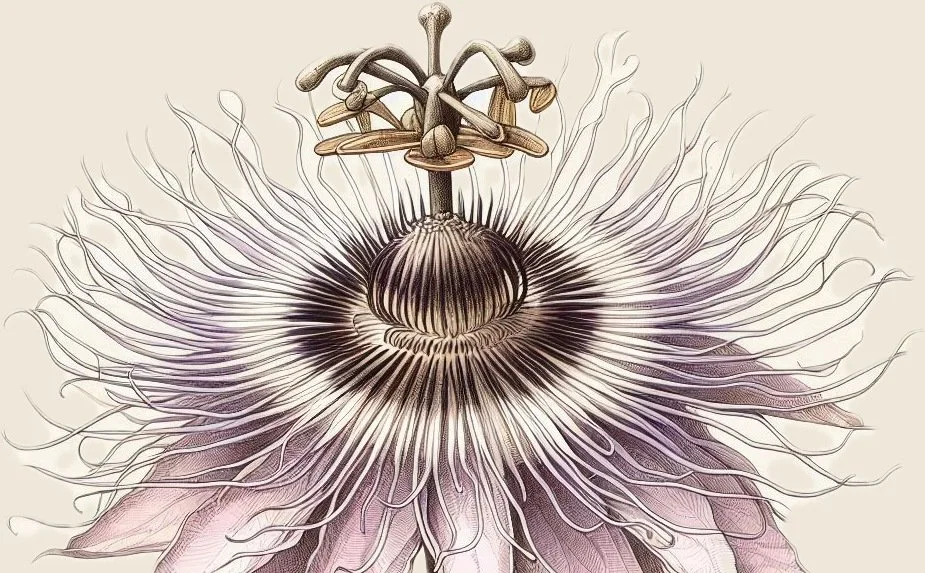
A climbing vine of the south-eastern United States, scrambling over fences and field edges, with extraordinary fringed purple flowers and an edible fruit, the maypop.
THE HARVEST
The leaves, stems and flowers are cut together in summer, at flowering, and dried.
FOLKLORE & TRADITIONAL USE
Spanish missionaries in the sixteenth century read the flower as a sign of the Passion: the fringed corona the crown of thorns, the five stamens the five wounds, the three stigmas the nails. It entered European herbal practice as a remedy for restlessness and sleeplessness.
EVIDENCE NOTE
The European Medicines Agency recognises passionflower as a traditional remedy for mild stress and to aid sleep. A trial of 65 people found a standardised extract improved total sleep time over 30 days; that was a different product, so the copy stays at traditional.
Melissa officinalis
Lemon balm: the bee’s herb
WHERE IT LIVES
A bushy perennial of the mint family from the eastern Mediterranean, now at home in gardens across Europe.
THE HARVEST
The leaves are cut just before flowering and dried gently, as the lemony volatile oil is easily lost.
FOLKLORE & TRADITIONAL USE
Melissa is Greek for honeybee, and beekeepers once rubbed their hives with it to keep a swarm at home. From 1611 the Carmelite nuns of Paris distilled it into Carmelite water, sold as a cordial for nerves and low spirits.
EVIDENCE NOTE
Small trials suggest lemon balm may ease mild nervous tension and support sleep, and a recent review calls for more rigorous trials. The European Medicines Agency recognises it for traditional use. Here it lifts the flavour and softens the valerian.
Lavandula angustifolia
Lavender: the soft floral close
WHERE IT LIVES
A small shrub of the dry mountain slopes of the western Mediterranean, grown for centuries in English gardens and fields. Mitcham, close to Herne Hill, was once famous for its lavender.
THE HARVEST
The flower spikes are cut in high summer, when about half the flowers on each spike are open, and dried in bunches.
FOLKLORE & TRADITIONAL USE
The Romans scented their baths and linens with it, and its name is often traced to the Latin lavare, to wash. Tudor households laid it among the bedding.
EVIDENCE NOTE
The strongest oral trials are for a proprietary lavender oil capsule and cannot be applied to a flower tincture. The European Medicines Agency recognises lavender flower as a traditional remedy for mild stress and to aid sleep, which is the claim made here.
How It Works as a Formula
All four plants appear on the European Medicines Agency’s list of herbs traditionally combined in sleep blends. Valerian is the working root, sedative and slow to build. Passionflower stands beside it for the mind that keeps turning.
Lemon balm and lavender complete the formula: gentle nervines in their own right, and the reason the tonic tastes of lemon and flowers rather than of earth alone.
IVDose & Safety
DOSE
Adults 10-20 ml, children 7+ 2-5 ml, in a little water, 30 minutes before bed.
CHILDREN
Children’s doses are given for ages 7 and over, as part of a consultation. If you are buying for a child, please complete the health questionnaire first, or book a short consultation, so the dose can be matched to them.
CAUTIONS
Not for children under 7. Not for use in pregnancy or breastfeeding. May cause drowsiness; do not drive or operate machinery after taking. Avoid alcohol, and speak to your practitioner if you take sedative or sleep medicines. Avoid with an allergy to the mint family (lemon balm, lavender). Contains alcohol.
DURATION
Up to four weeks, taken nightly. If sleep has not improved, seek advice.
Apothecary’s Summary
A deep, earthy sleep tonic for the season when the nights lengthen and the body asks for more of them. Four plants long combined for sleep, led by a root that rewards patience.
References
European Medicines Agency, HMPC. Assessment report on Species sedativae (herbal tea combinations for sleep).
European Medicines Agency, HMPC. European Union herbal monograph on Valeriana officinalis L., radix.
Bent, S. et al. (2006). Valerian for sleep: a systematic review and meta-analysis. The American Journal of Medicine, 119(12), 1005-1012.
Oxman, A.D. et al. (2007). A televised, web-based randomised trial of an herbal remedy (valerian) for insomnia. PLoS ONE, 2(10), e1040.
Randomised controlled trial of a standardised Passiflora incarnata extract and sleep (2024). PubMed Central PMC11026993.
Review of Melissa officinalis in anxiety and sleep (2025). PubMed 41226605.
Möller, H.J. et al. Trials of an oral lavender oil preparation (Silexan). PubMed Central PMC6726711.
Grieve, M. (1931). A Modern Herbal.