By the time the clocks go back, the body has already noticed. The nights lengthen, appetite reaches for heavier food, and the immune system settles into its winter footing. It is also the season when colds begin to move through offices, classrooms and crowded buses, and the first tickle in the throat arrives almost on cue.
In the hedgerows the elder hangs black with fruit, and for centuries those berries were gathered in September and kept for the cold months ahead. Further afield, other traditions kept their own winter stores: the bitter andrographis of the Indian plains, the yellow astragalus root and the lacquered reishi of Chinese medicine, each given to meet the cold months rather than simply endure them.
The Immune Keep keeps that habit of a winter store: a small group of plants chosen for the first days of a cold, bitter at the front, dark fruit for roundness, a root and a mushroom beneath to steady the whole.
This is the tonic for the first tickle, before the third day of hoping it will pass.
The Plants in the Field
Andrographis paniculata
Andrographis, the king of bitters, from the monsoon plains
An upright annual that grows fast through the monsoon in the moist, part-shaded ground of India and Sri Lanka. The whole aerial plant is cut as it comes into flower, when its bitterness is at its height. Taste it once and its Ayurvedic name, kalmegh, the dark cloud, makes perfect sense. It has long been given in India for fevers and a sluggish liver, and in Scandinavia a standardised andrographis has been a household winter remedy for decades.
Sambucus nigra
Elderberry, the hedgerow fruit kept for winter
Elder grows wherever people have lived: by back doors, along farm tracks, in the corners of old gardens and churchyards. By September the cream flowers of June have become heavy, drooping clusters of black fruit, picked before the birds strip them. Elderberry rob, a thick syrup of the cooked berries, was a favourite English remedy for colds, made in autumn and stored until it was needed.
Echinacea purpurea
Purple coneflower, a prairie flower turned winter remedy
A tall daisy of the North American prairies and open woods, its petals sweeping back from a spiny orange cone. The Plains nations used its relatives for wounds and fevers; by the early twentieth century it had crossed to Europe, where it became the classic remedy for the first sign of a cold.
Astragalus membranaceus
Astragalus, the yellow root of the northern grasslands
A modest, pea-flowered plant of the dry grasslands of northern China and Mongolia, left in the ground for four years or more before its long root is lifted in autumn. Sliced, it shows a pale yellow heart. In Chinese medicine it is the root given to those who catch every passing cold, to strengthen the body’s outer defences.
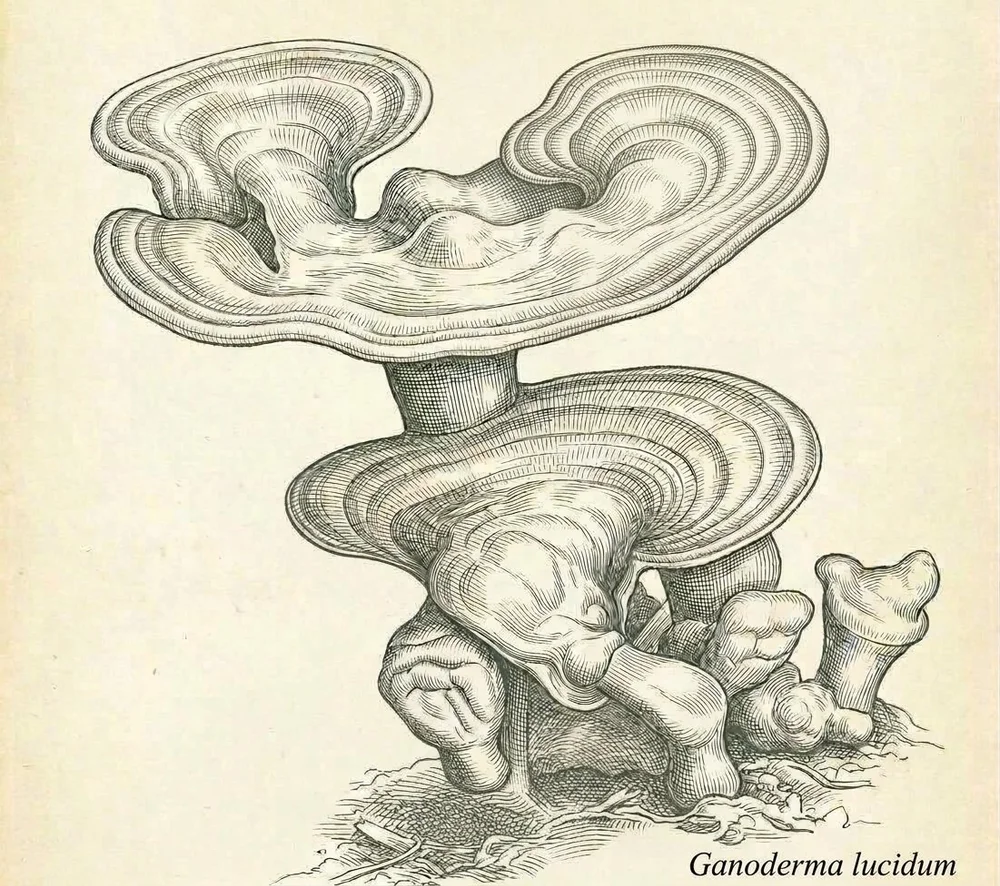
Ganoderma lucidum
Reishi, the lacquered mushroom of old oaks
A glossy, kidney-shaped bracket fungus that grows on dying hardwoods, especially oak, and looks as though it has been varnished. For two thousand years it has been painted and carved in China as the mushroom of long life. It is extracted twice, in water and in alcohol, to draw out everything it holds.
Thymus vulgaris
Thyme, the warm finish from stony hillsides
A low, woody shrub of the dry hills of the western Mediterranean, humming with bees in early summer when its flowering tops are cut. Culpeper called it a noble strengthener of the lungs, and it has been the herb of the winter chest in European households ever since.
Formulator’s Note
Every autumn I see the same thing in clinic: people who wait. The tickle arrives, or the heavy head, or the ache behind the eyes, and they carry on for three days hoping it will pass. By then the cold has its feet under the table.
Andrographis and elderberry are the foundation of this formula because they have the most evidence for those first days, and both are most useful taken early. Echinacea stands beside them, the remedy people have reached for at the first sign for a hundred years. Astragalus and reishi are slower. They belong to a tradition of strengthening rather than fighting, and they give the formula depth. Thyme is the warmth at the end, and it reaches for the chest, where a cold so often settles.
Six plants, one instruction: begin on the first day, keep warm, and rest.
These notes honour tradition and ecology. Full dosage and safety guidance live in the monographs.
References
Hu, X.Y. et al. (2017). Andrographis paniculata for symptomatic relief of acute respiratory tract infections in adults and children: a systematic review and meta-analysis. PLoS ONE, 12(8), e0181780.
Hawkins, J. et al. (2019). Black elderberry (Sambucus nigra) supplementation effectively treats upper respiratory symptoms: a meta-analysis. Complementary Therapies in Medicine, 42, 361-365.
Grieve, M. (1931). A Modern Herbal. Culpeper, N. (1653). The Complete Herbal.