IDescription
Six plants, one purpose: to meet a cold on the first day rather than the fifth. Bitterness leads, dark fruit rounds it, and beneath sit a root and a mushroom with long histories as winter tonics. Thyme closes the formula with warmth, reaching for the chest. Take it early and take it warm, and let it be the cue to slow down.
IIComposition
| Plant (part) | Actions |
|---|---|
| Andrographis paniculata (aerial parts) | Bitter; immunomodulatory; traditionally antipyretic |
| Sambucus nigra (fruit) | Antiviral (in vitro); antioxidant; traditionally diaphoretic |
| Echinacea purpurea | Immunomodulatory; traditionally taken at the first sign of a cold |
| Astragalus membranaceus (root) | Traditional immune tonic |
| Ganoderma lucidum (fruiting body, dual extract) | Immunomodulatory; traditional restorative |
| Thymus vulgaris (herb) | Expectorant; antispasmodic; antimicrobial (in vitro) |
IIIThe Plants
Andrographis paniculata
Andrographis, kalmegh: the king of bitters
WHERE IT LIVES
An annual of the Acanthaceae, native to the plains and lower hills of India and Sri Lanka and now grown across South and Southeast Asia. It favours moist, partly shaded ground and grows fast through the monsoon.
THE HARVEST
The aerial parts are cut as the plant comes into flower, when andrographolide, its principal bitter compound, is at its height.
FOLKLORE & TRADITIONAL USE
In Ayurveda it is kalmegh, the dark cloud, given for fevers and a sluggish liver, and its reputation as the king of bitters travelled with it. In Scandinavia a standardised andrographis preparation has been a familiar winter cold remedy for decades.
EVIDENCE NOTE
A 2017 systematic review of 33 trials (7,175 patients) found andrographis eased cough and sore throat and shortened time off sick in acute respiratory infections, though most trials used commercial products with little quality reporting. Serious adverse events are rare. This is the formula’s main evidence anchor.
Sambucus nigra
Elderberry: the hedgerow’s winter store
WHERE IT LIVES
A shrub of hedgerows, woodland edges and waste ground across Europe, often found close to houses and old farm buildings, as if it had chosen to stay near people.
THE HARVEST
The berries are gathered in late summer and early autumn, when the clusters hang heavy and fully black. Raw and unripe berries contain cyanogenic glycosides, so they are always dried, cooked or extracted before use.
FOLKLORE & TRADITIONAL USE
Elder was planted by the door to keep harm away, and in Danish tradition the Elder Mother lived in the tree and had to be asked before any wood was cut. John Evelyn, in Sylva (1664), wrote that if its medicinal virtues were fully known, there was hardly an ailment it could not help.
EVIDENCE NOTE
A 2019 meta-analysis of four small trials (180 participants) found elderberry substantially reduced upper respiratory symptoms; the trials used commercial extracts. Laboratory work shows activity against influenza viruses. A promising but modest evidence base.
Echinacea purpurea
Purple coneflower: from the prairie to the winter cupboard
WHERE IT LIVES
A member of the Asteraceae native to the open woods and prairies of central and eastern North America, now widely cultivated across Europe.
THE HARVEST
Aerial parts are cut at full flower; roots are lifted in autumn from plants three or four years old.
FOLKLORE & TRADITIONAL USE
The Plains nations used echinacea, mostly E. angustifolia, for wounds, burns, toothache and snakebite. It entered American medicine in the 1880s as a patent blood purifier, and German research in the 1930s brought E. purpurea into European practice, where it became the classic remedy for the first sign of a cold.
EVIDENCE NOTE
A Cochrane review (2014) found echinacea products have not been shown to treat colds, though a weak benefit from some preparations cannot be ruled out. Products vary widely in species, plant part and extraction, which makes the evidence hard to read. Its place here is traditional.
Astragalus membranaceus
Astragalus, huang qi: the yellow root
WHERE IT LIVES
A perennial of the pea family from the dry grasslands and hillsides of northern China and Mongolia.
THE HARVEST
The roots are lifted from plants four years old or more, usually in autumn, then sliced and dried. The cut root shows a pale yellow core, the huang of its name.
FOLKLORE & TRADITIONAL USE
In Chinese medicine huang qi is a principal tonic, said to strengthen the body’s protective layer. It leads Yu Ping Feng San, the jade windscreen formula, traditionally given to those who catch every passing cold.
EVIDENCE NOTE
Laboratory studies show immune-modulating activity in its polysaccharides, but a Cochrane review (2016) found no placebo-controlled trials for preventing infections in children. It is written here as traditional.
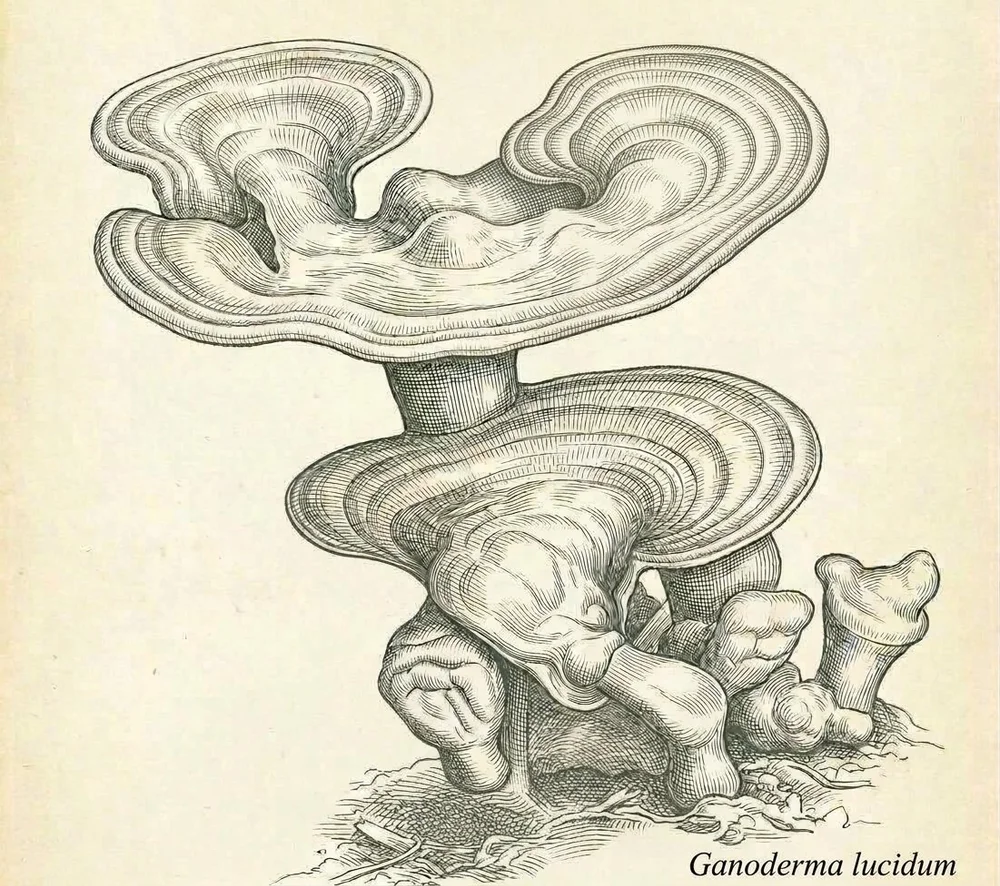
Ganoderma lucidum
Reishi, lingzhi: the mushroom of long life
WHERE IT LIVES
A glossy, lacquered polypore growing on dead and dying hardwoods, especially oak, across Asia, Europe and North America. Most reishi today is cultivated on logs or wood substrates.
THE HARVEST
The fruiting bodies are picked once the pale growing edge of the cap has darkened. Its polysaccharides dissolve in water and its triterpenes in alcohol, so it is extracted twice and the two combined.
FOLKLORE & TRADITIONAL USE
Listed among the superior herbs of the Shennong Bencao Jing, compiled around two thousand years ago, and painted through centuries of Chinese art as the lingzhi carried by immortals, a symbol of long life.
EVIDENCE NOTE
Immune-modulating activity is well described in the laboratory. Human evidence is early: a 2020 pilot trial in 60 elderly residents gave reishi with elderberry, so its own effect cannot be separated. It may increase bleeding risk alongside blood-thinning medicines.
Thymus vulgaris
Garden thyme: the warm finish
WHERE IT LIVES
A low, woody shrub of the mint family from the dry, stony hillsides of the western Mediterranean.
THE HARVEST
The leafy flowering tops are cut in early summer on a dry day, when the volatile oil, rich in thymol, is at its height.
FOLKLORE & TRADITIONAL USE
The Greeks burned thyme as incense and linked it with courage. Culpeper called it “a noble strengthener of the lungs, as notable a one as grows”.
EVIDENCE NOTE
The European Medicines Agency recognises thyme as a traditional expectorant for productive cough with colds. A trial of thyme combined with ivy leaf found faster recovery from acute bronchitis. Here it warms the finish and supports the cough that so often follows a cold.
How It Works as a Formula
Andrographis and elderberry are the working core: the most studied herb in the blend for the early days of a cold, and the dark fruit that has carried households through winters for centuries. Echinacea stands with them at the front, taken at the first sign as it has been for over a hundred years.
Behind them, astragalus and reishi are the slow tonics, the root and the mushroom that traditional medicine gives to steady the body’s defences rather than rouse them. Thyme closes the formula, warming the finish and reaching for the chest.
IVDose & Safety
DOSE
Adults 5-10 ml, children 7+ 1-2 ml, in a little warm water, two to three times daily, from the first signs of a cold.
CHILDREN
Children’s doses are given for ages 7 and over, as part of a consultation. If you are buying for a child, please complete the health questionnaire first, or book a short consultation, so the dose can be matched to them. Echinacea is not generally advised for under-12s in the UK without professional guidance (MHRA, 2012).
CAUTIONS
Not for children under 7. Not for use in pregnancy or breastfeeding. Avoid with an allergy to the daisy family (echinacea), the mint family (thyme) or mushrooms. Avoid with autoimmune conditions or immunosuppressant medicines unless advised by your practitioner. Reishi may increase bleeding risk with anticoagulant and antiplatelet medicines, and may add to the effect of blood pressure and diabetes medicines. Take care with liver disease. Contains alcohol.
DURATION
Up to 10 days at a time. If symptoms worsen or last longer, seek medical advice. Not intended for continuous use through the winter.
Apothecary’s Summary
A bitter, deep tonic built for the first day of a cold. Six plants with long winter histories, one with a strong modern evidence base, all asking the same of the person taking them: begin early, keep warm, rest.
References
Hu, X.Y. et al. (2017). Andrographis paniculata for symptomatic relief of acute respiratory tract infections in adults and children: a systematic review and meta-analysis. PLoS ONE, 12(8), e0181780.
Worakunphanich, W. et al. (2021). Safety of Andrographis paniculata: a systematic review and meta-analysis. Pharmacoepidemiology and Drug Safety.
Hawkins, J. et al. (2019). Black elderberry (Sambucus nigra) supplementation effectively treats upper respiratory symptoms: a meta-analysis of randomized controlled clinical trials. Complementary Therapies in Medicine, 42, 361-365.
Krawitz, C. et al. (2011). Inhibitory activity of a standardized elderberry liquid extract against respiratory bacterial pathogens and influenza A and B viruses. BMC Complementary and Alternative Medicine, 11, 16.
Karsch-Völk, M. et al. (2014). Echinacea for preventing and treating the common cold. Cochrane Database of Systematic Reviews, CD000530.
Cochrane Database of Systematic Reviews (2016). CD011958.pub2 (astragalus and the prevention of infections in children).
Gracián-Alcaide, C. et al. (2020). Elderberry and reishi supplementation in an elderly population: a pilot randomised trial. Applied Sciences, 10(22), 8259.
Kemmerich, B. et al. (2006). Efficacy and tolerability of a fluid extract combination of thyme herb and ivy leaves in adults with acute bronchitis and productive cough. Arzneimittelforschung, 56(9), 652-660.
European Medicines Agency, HMPC. Community herbal monograph on Thymus vulgaris L. and Thymus zygis L., herba.
Culpeper, N. (1653). The Complete Herbal. Evelyn, J. (1664). Sylva.