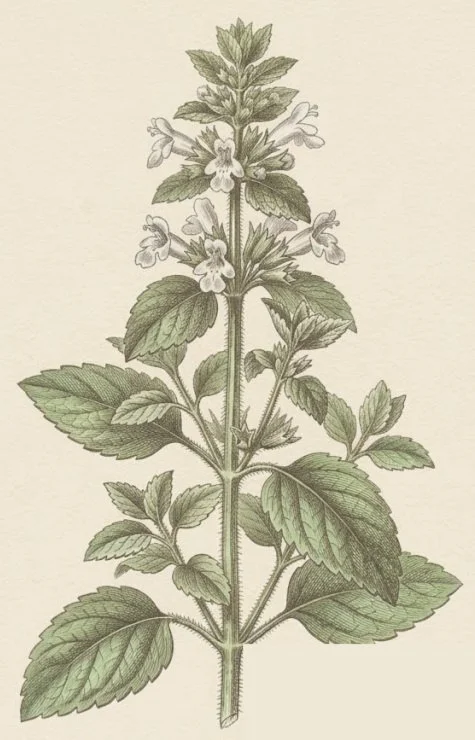
IDescription
Five plants for the last cup of the day. This is the lighter companion to Deep Sleep, for evenings that come in early and nights that need only a nudge. Passionflower and skullcap do the settling, lemon balm lifts and softens, and lavender and rose bring the scent, which is half the point. Drink it slowly, with the lights low, as the last thing the day asks of you.
IIComposition
| Plant (part) | Actions |
|---|---|
| Passiflora incarnata (aerial parts) | Anxiolytic; mild sedative |
| Scutellaria lateriflora (aerial parts) | Nervine; mild sedative |
| Melissa officinalis (leaf) | Calming nervine; carminative |
| Lavandula angustifolia (flower) | Calming nervine; aromatic |
| Rosa damascena (petal and bud) | Aromatic; mood-lifting by tradition |
IIIThe Plants
Passiflora incarnata
Passionflower: the settling herb
WHERE IT LIVES
A fast-climbing vine native to the south-eastern United States, at home on woodland edges and fence lines, where its purple flowers open for a single day.
THE HARVEST
The whole aerial plant, leaf, stem and flower, is cut at flowering in summer and dried for tea.
FOLKLORE & TRADITIONAL USE
Its name comes from sixteenth-century Spanish missionaries, who saw the instruments of the Passion in its flower. In the herbal practice that followed, it became a remedy for the restless mind at the end of the day.
EVIDENCE NOTE
The European Medicines Agency recognises passionflower as a traditional remedy for mild stress and to aid sleep. A trial of a standardised extract found improved total sleep time; in a tea, the claim stays at traditional.
Scutellaria lateriflora
American skullcap: the quiet nerve
WHERE IT LIVES
A slender perennial of the mint family, at home in the damp woods, riverbanks and wet meadows of North America, with small blue flowers held along one side of the stem.
THE HARVEST
The aerial parts are cut in flower in midsummer and dried gently.
FOLKLORE & TRADITIONAL USE
Its name comes from the tiny cap-shaped cup behind each flower. The nineteenth-century American Eclectic physicians prescribed it as a nervine, for restlessness and nerves worn thin.
EVIDENCE NOTE
There is no European Medicines Agency monograph for skullcap. One small randomised, placebo-controlled trial in healthy volunteers found it improved mood; for sleep, the evidence is traditional. Older reports of liver harm were traced largely to products adulterated with germander, so it is bought only from a verified supplier.
Melissa officinalis
Lemon balm: the gentle lift
WHERE IT LIVES
A bushy perennial of the mint family from the eastern Mediterranean, long at home in English cottage gardens, where bees crowd its small white flowers.
THE HARVEST
The leaves are cut just before flowering, in early summer, and dried quickly in the shade to keep their lemon scent.
FOLKLORE & TRADITIONAL USE
Its name is the Greek for honeybee, and beekeepers once rubbed their hives with it. In seventeenth-century Paris, Carmelite nuns made a lemon balm cordial that was taken for the nerves.
EVIDENCE NOTE
The European Medicines Agency recognises lemon balm leaf as a traditional remedy for mild symptoms of stress and to aid sleep, in adults and young people over 12. Here it rounds the blend as much as it calms.
Lavandula angustifolia
Lavender: the scent of the linen cupboard
WHERE IT LIVES
A low, silver-leaved shrub of the sunny, stony mountain slopes of the western Mediterranean, long naturalised in English gardens.
THE HARVEST
The spikes are cut in July, when the lower flowers have opened and the upper ones are still in bud, and dried for their scent.
FOLKLORE & TRADITIONAL USE
Laid among sheets and pillows for centuries, lavender has long been the English scent of rest. Its oil was once distilled commercially just south of London, in Mitcham.
EVIDENCE NOTE
The European Medicines Agency recognises lavender flower as a traditional remedy for mild stress and to aid sleep. A meta-analysis found lavender oil aromatherapy improved sleep, though those trials used the oil, not the flower in a tea.
Rosa damascena
Damask rose: the soft floral note
WHERE IT LIVES
An ancient hybrid rose long grown in Persia and Syria, named for Damascus, and today cultivated in Bulgaria’s Valley of Roses, in Ta’if and in Iran.
THE HARVEST
Buds and petals are picked by hand at dawn in early summer, when the scent is strongest, and dried in the shade.
FOLKLORE & TRADITIONAL USE
Persian physicians perfected the distillation of rose water a thousand years ago, and the rose has carried a reputation for calm and comfort ever since. It is said to have reached Europe with returning Crusaders.
EVIDENCE NOTE
No sleep evidence was found for rose petals in a tea. Trials of rose oil aromatherapy suggest benefits for mood and sleep, mostly in hospital settings. Here it is scent and softness, and nothing more is claimed.
How It Works as a Formula
Passionflower is the working herb, the one with a sleep tradition and the beginnings of trial evidence. Skullcap sits beside it, the old nervine for a restless mind, and lemon balm adds a soft lemon lift that rounds the cup. Lavender brings its own gentle calming reputation, and rose makes the tea something you want to hold under your nose for a while. The breathing, the steam and the dimmed lights do the rest.
IVDose & Safety
DOSE
Infuse 1-2 teaspoons in freshly boiled water, covered, for 10-15 minutes. Adults and children 7+: one cup 30-60 minutes before bed.
CAUTIONS
Not for children under 7. Not for use in pregnancy or breastfeeding. May cause drowsiness; do not drive or operate machinery after drinking. Speak to your practitioner if you take sedative or sleep medicines. Avoid with an allergy to the mint family (skullcap, lemon balm, lavender).
DURATION
Up to two weeks. If sleep has not improved, seek advice.
Apothecary’s Summary
A soft, floral tea for the last cup of the day. Two settling herbs, a lemon-scented leaf and two scented flowers, made for nights that need a nudge rather than a push.
References
European Medicines Agency, HMPC. Draft European Union herbal monograph on Species sedativae (passionflower and lavender flower: not established under 12).
Randomised controlled trial of a standardised Passiflora incarnata extract and sleep (2024). PubMed Central PMC11026993.
European Medicines Agency, HMPC. European Union herbal monograph on Melissa officinalis L., folium.
Brock, C. et al. (2014). American skullcap (Scutellaria lateriflora): a randomised, double-blind, placebo-controlled crossover study of its effects on mood in healthy volunteers. Phytotherapy Research, 28(5), 692-698.
NIH LiverTox. Skullcap (germander adulteration).
Meta-analysis of lavender essential oil aromatherapy and sleep, 11 RCTs, 628 adults (2025). Holistic Nursing Practice. PubMed 40600743.
Meta-analysis of Rosa damascena aromatherapy on mood and sleep, 28 RCTs. PubMed Central PMC12623198.