IDescription
Five plants for the ten minutes after a meal. Winter food is slower food, and the appetite that reaches for it needs a little help to keep pace. Chamomile settles, peppermint clears, yarrow brings a faint bitter edge, ginger warms, and marigold turns the cup gold. Drink it after the meal, not with it, and let the table clear around you.
IIComposition
| Plant (part) | Actions |
|---|---|
| Matricaria recutita (flower) | Carminative; antispasmodic; anti-inflammatory |
| Mentha × piperita (leaf) | Carminative; antispasmodic |
| Achillea millefolium (herb) | Aromatic bitter; antispasmodic |
| Zingiber officinale (root) | Warming carminative; antiemetic |
| Calendula officinalis (flower) | Colour and floral note |
IIIThe Plants
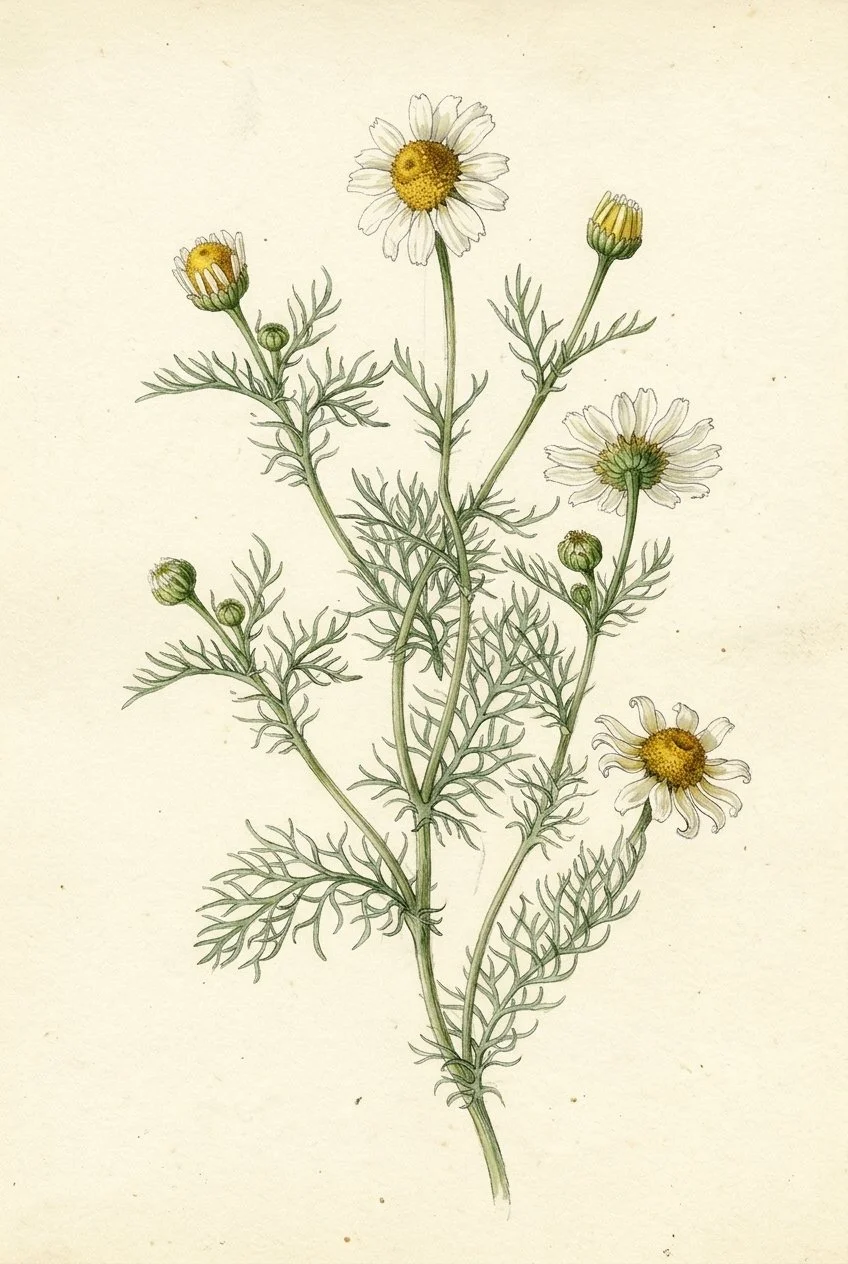
Matricaria recutita
German chamomile: the settling flower
WHERE IT LIVES
A small annual of the daisy family, once a weed of cornfields and field margins across Europe, now cultivated on a large scale.
THE HARVEST
The flower heads are picked in early summer, when fully open, by hand or with a wide-toothed comb, and dried gently to protect their blue-tinged oil.
FOLKLORE & TRADITIONAL USE
Chamomile tea has been the household answer to an uneasy stomach for centuries. In Beatrix Potter’s The Tale of Peter Rabbit, Mrs Rabbit doses Peter with a tablespoon of it at bedtime after his feast in Mr McGregor’s garden.
EVIDENCE NOTE
The European Medicines Agency recognises chamomile flower for traditional use in mild digestive complaints, with tea doses given from the age of two. It is the most gently established herb in the blend.
Mentha × piperita
Peppermint: the clearing herb
WHERE IT LIVES
A sterile hybrid of water mint and spearmint, spreading by runners through damp, rich ground.
THE HARVEST
The leaves are cut just before the plant flowers, when the menthol-rich oil peaks, then dried in the dark.
FOLKLORE & TRADITIONAL USE
Mints were strewn on floors and served after feasts in ancient Greece and Rome, and peppermint tea after dinner is the direct descendant of that habit.
EVIDENCE NOTE
The European Medicines Agency recognises peppermint leaf for traditional use in indigestion and wind. The strong clinical trials are for enteric-coated peppermint oil capsules in irritable bowel syndrome, not for the tea. It may aggravate reflux.
Achillea millefolium
Yarrow: the faint bitter edge
WHERE IT LIVES
A tough perennial of meadows, verges and lawns across the northern hemisphere, with finely divided, feathery leaves.
THE HARVEST
The flowering tops are cut in summer and dried in loose bunches.
FOLKLORE & TRADITIONAL USE
Long given in European folk practice as a bitter to wake a flagging appetite, and as a gentle remedy for a cramping stomach.
EVIDENCE NOTE
The European Medicines Agency recognises yarrow for loss of appetite and mild spasmodic digestive complaints, in adults and young people over 12. Here it is well matched to its purpose.
Zingiber officinale
Ginger: the warm finish
WHERE IT LIVES
A tropical perennial with tall, reed-like leaves, long cultivated across South and Southeast Asia and no longer known in the wild.
THE HARVEST
The knotted rhizome, the “root”, is lifted eight to ten months after planting, when its warmth is fullest, then sliced and dried.
FOLKLORE & TRADITIONAL USE
Ginger travelled west along the spice routes and became one of the most common spices of medieval Europe. It survives in the gingerbread of winter fairs and in the old habit of a warming spice after a heavy meal.
EVIDENCE NOTE
The European Medicines Agency recognises ginger root for the prevention of nausea in travel sickness, and for traditional use in mild cramp-like digestive complaints, including bloating and wind. Clinical trials are mostly of standardised powdered root, not tea, so the cup’s effect is gentler and less studied.
Calendula officinalis
Marigold: Mary’s gold
WHERE IT LIVES
A hardy annual from the Mediterranean, at home in cottage gardens across Europe, flowering from early summer until the first frosts.
THE HARVEST
The flower heads are picked as they open, through the summer; the more they are picked, the more they flower.
FOLKLORE & TRADITIONAL USE
Known as poor man’s saffron, its petals once coloured butter, cheese and winter broths. Its English name, Mary’s gold, comes from its association with the Virgin Mary.
EVIDENCE NOTE
The European Medicines Agency recognises calendula for skin, wounds and inflammation of the mouth and throat, not the gut. It is here for colour and its soft floral note, and no digestive claim is made for it.
How It Works as a Formula
Chamomile and peppermint are the working pair, both recognised for traditional use in indigestion, one soothing and one clearing. Yarrow adds the bitter edge that wakes digestion, and ginger warms the finish, as it has in winter food for centuries.
Marigold asks nothing of the stomach. It turns the cup gold, and makes the ten minutes after a meal something worth sitting for.
IVDose & Safety
DOSE
Infuse 1-2 teaspoons in freshly boiled water, covered, for 10 minutes. Adults and children 7+: one cup after meals, up to three daily.
CAUTIONS
Not for children under 7. Not for use in pregnancy or breastfeeding. Avoid with an allergy to the daisy family (chamomile, yarrow, calendula) or the mint family (peppermint). Take care with blood-thinning medicines (ginger). Peppermint may aggravate reflux.
DURATION
Up to two weeks. Seek medical advice if symptoms persist, or with blood in the stool or unexplained weight loss.
Apothecary’s Summary
A golden tea for the heavier meals of winter. Two well-established digestive herbs, a bitter, a warming spice and a flower for colour, steeped together for the slow minutes after the plates are cleared.
References
European Medicines Agency, HMPC. European Union herbal monograph on Matricaria recutita L., flos.
European Medicines Agency, HMPC. Community herbal monograph on Mentha × piperita L., folium.
European Medicines Agency, HMPC. Community herbal monograph on Achillea millefolium L., herba.
European Medicines Agency, HMPC. Community list entry on Calendula officinalis L., flos.
European Medicines Agency, HMPC. Community herbal monograph on Zingiber officinale Roscoe, rhizoma.
National Center for Complementary and Integrative Health. Peppermint oil.
Potter, B. (1902). The Tale of Peter Rabbit. Frederick Warne.